
Loading dispatches...
← Return to NewsroomScience
Shoebox-sized 'detector satellites' could sniff out a nuclear bomb in space
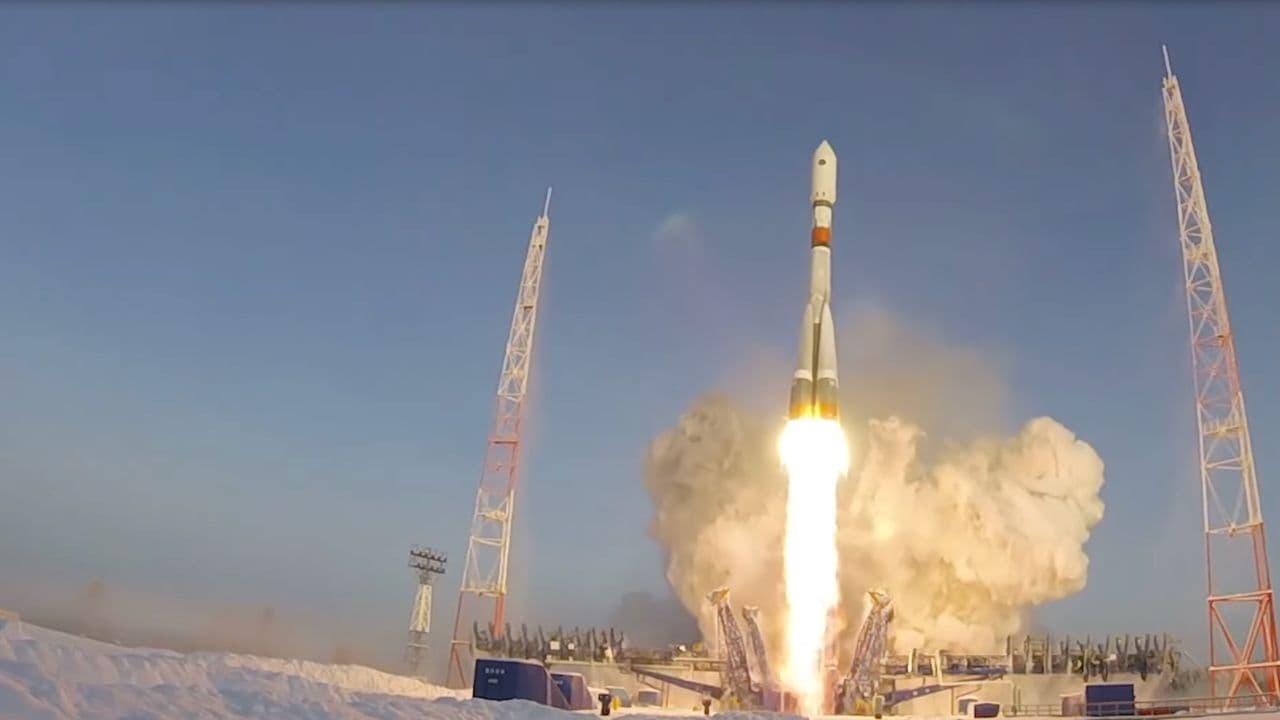
A Russian Soyuz-2.1a rocket launches the Kosmos-2553 satellite from Plesetsk Cosmodrome on Feb. 5, 2022. Some outside observers have speculated that Kosmos-2553 might be testing components for a future orbital nuclear weapon. (In 2024, rumors began to swirl in military circles that Russia might be developing a space-borne nuclear weapon. At that time, two years into the war in Ukraine, Russia was well aware of how big a lifeline SpaceX's Starlink broadband constellation had been for the Ukrainians. Starlink has not only provided connectivity to ravaged cities and frontline troops but also helped Ukrainians counter-attack the Russian invaders more effectively.Drones fitted with Starlink terminals could reach much more distant targets than those controlled via conventional radio links. As the Starlink signal is almost impossible to disrupt by jamming, the idea that Russia might consider wiping the megaconstellation out by brute force didn't seem impossible.Researchers know that a nuclear detonation in orbit would flood the space around Earth with fast, energetic electrons. These particles would destroy most unhardened satellites within range, which would extend to orbits even hundreds of miles away from the explosion."It would make the low Earth orbit and very low Earth orbit — where the Starlink satellites are, where many reconnaissance and communications satellites are, and where the International Space Station is — uninhabitable for a long period of time," Areg Danagoulian, an associate professor of nuclear science and engineering at the Massachusetts Institute of Technology and the author of the new paper describing the proposed detection method, told Space.com."We would essentially not only lose the satellites in those orbits, we would lose those orbits for a few years," he added.Humankind has already seen the effects of a nuclear explosion in space. In 1962, the U.S. detonated a 1.4-megaton hydrogen bomb at an altitude of 240 miles (400 kilometers) above the Pacific Ocean. Radiation from the explosion, known as the Starfish Prime test, destroyed one-third of all satellites in orbit at that time. Admittedly, there weren't that many up there — fewer than 100 — but the impact was far-reaching.Today, a nuclear detonation in space would be a catastrophe. It would knock out internet-beaming constellations such as Starlink and Amazon Leo, as well as hundreds of Earth-observing satellites that keep an eye on the activity of adversary nations, the changing climate and areas struck by natural disasters. Photograph of an aurora caused by the Starfish Prime high-altitude nuclear test explosion on July 9, 1962. ( Danagoulian proposes a constellation of small "9U" cubesats, each one about the size of a large shoebox and each carrying a special detector capable of sensing radiation emitted by unexploded nulear bombs.He explores a scenario in which Russia launches a suspected space nuke into an orbit with an altitude of 1,200 miles (2,000 km). That number is not random. In 2022, Russia's Kosmos 2553 satellite, orbiting at that exact altitude, triggered suspicions it might be testing components for a future orbital nuclear weapon.Russia claims the satellite just observes Earth. At that altitude, the satellite passes through the Van Allen belt, a region of intense cosmic radiation trapped by Earth's magnetic field. Most of the belt stretches between altitudes of around 600 miles (1,000 km) to tens of thousands of miles, but in some areas the radiation can reach much closer to Earth's surface.The interaction between the fissile material inside the nuke and the energetic particles from the radiation belt would create distinct signatu
Two images, captured by the Earth-imaging company Vantor, showing changing water levels at the Hoover Dam. ( The images are available in near-real time, revealing immediate effects of natural disasters and armed conflict. What is more, the images are also absolutely stunning.Vantor, which operates a fleet of 10 satellites that image the surface of the planet with a resolution of 12 inches (30 centimetres), released the first set of its 3D shots from space on July 1. The images capture a variety of targets, all in amazing detail.For example, there are shots of iconic landmarks in Paris; the Eiffel Tower, the Arc de Triomphe and the modernist quarter La Défense emerge in the images as if seen from a landing plane. Other image sets track the progress of ship-building activity at China's Yulin Naval Base and decreasing water levels at Arizona's Hoover Dam. The Eiffel Tower, captured by a satellite operated by the Earth-observation company Vantor. (The 3D views are created by combining multiple satellite images taken from different angles and are updated every 24 hours or less to track even the most rapidly occurring changes in the landscape. The images form a basis for 3D maps that could, for example, help autonomous drones navigate in areas hit by GPS jamming.The satellite fleet's ability to rapidly update the imagery is a unique feature that was impossible to achieve by other 3D mapping technologies. Most commonly, mapmakers and organizations would have to conduct costly imaging campaigns from aboard aircraft or using remotely controlled drones. Neither of these approaches, however, allows such regular and frequent revisits, according to Vantor. On top of that, drones and planes may not be able to safely access and map areas controlled by unfriendly nations. The Arc de Triomphe in Paris, captured by a satellite operated by the Earth-observation company Vantor. ("With WorldView 3D, customers can update the specific areas they care about, including remote and contested areas where traditional aircraft collection is limited, with unmatched speed and scale," Wilczynski added. "This is the future of spatial intelligence." Tereza is a London-based science and technology journalist, aspiring fiction writer and amateur gymnast. She worked as a reporter at the Engineering and Technology magazine, freelanced for a range of publications including Live Science, Space.com, Professional Engineering, Via Satellite and Space News and served as a maternity cover science editor at the European Space Agency.
Discussion (0)