
Loading dispatches...
← Return to NewsroomScience
Engineers race to save stricken LINK rescue spacecraft before it's too late
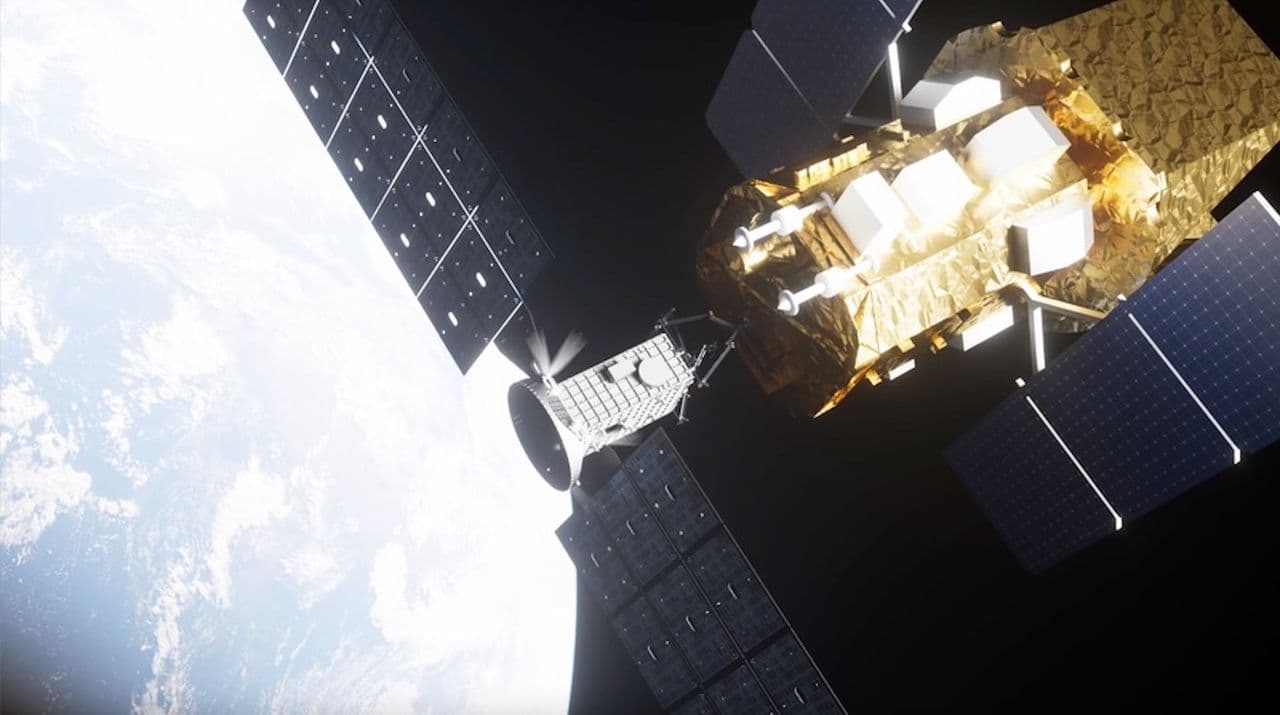
Artist's illustration of Katalyst Space Technologies' LINK spacecraft meeting up with NASA's Swift space telescope in Earth orbit. (LINK, a satellite built and operated by the Arizona company Katalyst Space Technologies, launched July 3 on a daring and unprecedented mission: Rendezvous with NASA's Swift space telescope and boost the observatory to a higher orbit before it falls out of the sky.About three weeks after launch, however, LINK started spinning at an unexpected rate, a problem that caused a temporary communications dropout and a reset of its satellite platform. And two of LINK's three orientation-controlling reaction wheels stopped working.Spacecraft operators always work hard to fix such problems when they crop up, but there's a special urgency where LINK is concerned. It needs to reach Swift soon, or atmospheric drag will pull the observatory — which possesses no thrusters of its own — down past a point of no return. NASA thinks this boundary lies at around 186 miles (300 kilometers) above Earth, an altitude that Swift is expected to reach by October.So the original plan called for LINK to meet up with Swift in early August, just a month after launch — pretty much as soon as commissioning work on the rescue craft wrapped up. That's not going to happen at this point, but mission teams haven't given up on the rescue attempt. Indeed, they're making progress on getting LINK back up to speed, as a new update relates."LINK originally was in a multi-axis spin rotating at about 9 degrees per second, which resulted in sporadic communications and impeded LINK’s progress toward Swift," NASA officials wrote in the update, which the agency posted on Thursday (Aug. 6)."Using a series of burns from one of LINK’s electric propulsion thrusters, the Katalyst team now has slowed that spin to about 1.47 degrees per second," they added. "Katalyst plans to keep LINK at that spin rate as it proceeds with next steps for the mission."Those next steps include uploading flight software updates "with new attitude controllers designed to maintain LINK’s stability in its current configuration," NASA officials wrote. "These updates would allow LINK to begin maneuvering to align with Swift’s orbit."The updates are expected to be beamed up to LINK "in the coming days," according to the update. Artist's illustration of Katalyst Space Technologies' Link servicing spacecraft approaching and capturing NASA's Swift space observatory on an orbit-boosting mission. (The $250 million telescope's initial altitude was about 375 miles (600 km). But it has fallen considerably since then, and the descent is accelerating: The lower Swift goes, the more atmosphere it encounters and the greater the force of frictional drag becomes.Swift is still working just fine, which explains why NASA wants to save it. Last September, the agency awarded Katalyst $30 million to build LINK — a refrigerator-sized spacecraft with three robotic arms — and fly its rescue mission.That's a very tight timeline, but Katalyst hit it, getting LINK ready by its launch date and checking off a number of commissioning milestones before running into trouble. The company has experience delivering under pressure, so maybe it can pull off the rescue craft's rescue before it's too late. Michael Wall is the Spaceflight and Tech Editor for Space.com and joined the team in 2010. He primarily covers human and robotic spaceflight, military space, and exoplanets, but has been known to dabble in the space art beat. His book about the search for alien life, "Out There," was published on Nov. 13, 2018. Before becoming a science writer, Michael worked as a herpetologist and wildlife biologist. He has a Ph.D. in evolutionary
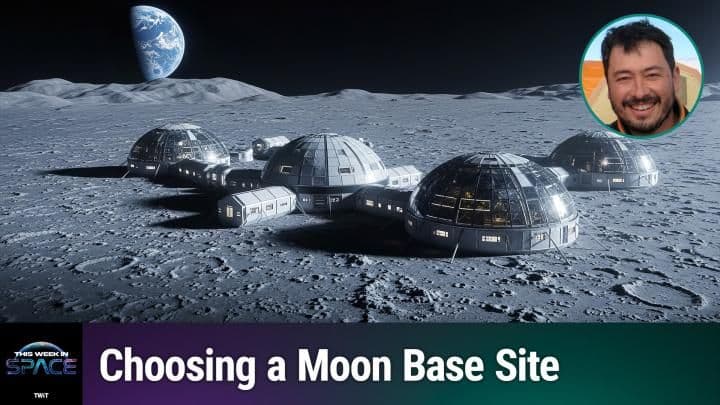
Which Way to the Moonbase? - With Dr. Pascal Lee - YouTube Watch On On Episode 218 of This Week In Space, Rod Pyle and Tariq Malik discuss NASA's new moonbase plans with planetary scientist Dr. Pascal Lee.Starting with Artemis V (so far), the US plans to begin preparations for a permanent base situated in the south polar regions of the moon. Details are somewhat fluid, but one thing stands out: the poles are likely to be the most challenging places to set up shop in an already hostile environment. Pascal joins us to discuss moonbase siting options and why the poles may not be the best choice at first.Space news of the weekMaking history! China lands rocket during an orbital launch for 1st time everNASA's New Horizons probe just woke up from hibernation 6 billion miles away beyond Pluto. What's it doing out there?Wally Funk, trailblazing pilot and astronaut, passes away at 87Moon Base - NASAProject Horizon - WikipediaThe Artemis AccordsNASA, Department of Energy to Develop Lunar Surface Reactor by 2030Model Falcon 9!Finally, did you know you can launch your own SpaceX rocket? Model rocket maker Estes' stunning scale model of a Falcon 9 rocket that you can pick up now. The launchable model is a detailed recreation of the Falcon 9 and retails for $149.99. You can save 10% by using the code IN-COLLECTSPACE at checkout, courtesy of our partners collectSPACE.com.About This Week In SpaceThis Week in Space covers the new space age. Every Friday we take a deep dive into a fascinating topic. What's happening with the new race to the moon and other planets? When will SpaceX really send people to Mars?Join Rod Pyle and Tariq Malik from Space.com as they tackle those questions and more each week on Friday afternoons. You can subscribe today on your favorite podcatcher.Host of This Week In Space on TWiTHost of This Week In Space on TWiTRod Pyle is an author, journalist, television producer and Editor-in-Chief of Ad Astra magazine. He has written 18 books on space history, exploration, and development, including Space 2.0, Innovation the NASA Way, Interplanetary Robots, Blueprint for a Battlestar, Amazing Stories of the Space Age, First On the Moon, and Destination MarsIn a previous life, Rod produced numerous documentaries and short films for The History Channel, Discovery Communications, and Disney. He also worked in visual effects on Star Trek: Deep Space Nine and the Battlestar Galactica reboot, as well as various sci-fi TV pilots. His most recent TV credit was with the NatGeo documentary on Tom Wolfe's iconic book The Right Stuff.This Week In Space co-hostThis Week In Space co-hostResponsible for Space.com's editorial vision, Tariq Malik has been the Editor-in-Chief of Space.com since 2019 and has covered space news and science for 18 years. He joined the Space.com team in 2001, first as an intern and soon after as a full-time spaceflight reporter covering human spaceflight, exploration, astronomy and the night sky. He became Space.com's managing editor in 2009. As on-air talent has presented space stories on CNN, Fox News, NPR and others.Tariq is an Eagle Scout (yes, he earned the Space Exploration merit badge), a Space Camp veteran (4 times as a kid, once as an adult), and has taken the ultimate "vomit comet" ride while reporting on zero-gravity fires. Before joining Space.com, he served as a staff reporter for The Los Angeles Times covering city and education beats. He has journalism degrees from the University of Southern California and New York University. Space.com is the premier source of space exploration, innovation and astronomy news, chronicling (and celebrating) humanity's ongoing expansion across the final frontier. Originally founded in 1999, Space.com is, and always has been, the passion of writers and editors who are space fans and also trained journalists. Our current news team consists of Editor-in-Chief Tariq Malik; Editor Hanneke Weitering, Senior Space Writer Mike Wall; Senior Writer Meghan Bartels; Senior Writer
An American flag in the cupola of the International Space Station. (S. Supreme Court protecting voter rights could extend to astronauts living and working in space and training internationally, their families, and the multitude of NASA workers who travel to support their missions.On Monday (June 29), the Supreme Court ruled that mail-in ballots can be counted toward a total vote even if they arrive after election day, as long as they are postmarked by election day. The ruling followed efforts by the Trump Administration to place restrictions on mail-in voting. In a new statement, the nonpartisan activist organization Astronauts for America spoke out in support of the Supreme Court's decision, which supports absentee voting."We don't want to see barriers put in place [that] make it more challenging for somebody to exercise their constitutional right of voting," retired NASA astronaut Wendy Lawrence told Space.com. Lawrence is a member of Astronauts for America, as well as a veteran of the U.S. Navy, where she served as a captain, engineer and helicopter pilot.What happened?An executive order issued by President Trump in March 2026 attempted to place a number of restrictions on voting in the country, including limitations on mail-in or absentee voting. The order directed the United States Postal Service to only transmit ballots for states that compile and submit lists of eligible mail-in voters 60 days before elections, added requirements and complications to mail-in ballots and attempted to limit who receives a ballot in the mail.This order not only added layers to limit voting access, but it conflicted with existing procedures set by states for absentee voting. Additionally, the U.S. Constitution places the authority to change election rules and processes with Congress, not the president, though this was not the first executive order put out by Trump to attempt to change election rules, CNN has reported.In a 5-4 ruling, the Supreme Court blocked the U.S. Postal Service from carrying out this executive order, declaring that mail-in ballots may be counted if they arrive up to five days after election day, as long as they are postmarked by election day."This is key to making sure we have free and fair elections, that people have the ability to cast their vote, and it's not an overwhelming burden for them to do that again," said Lawrence.Astronauts vote (and so do the people around them)In a statement shared on social media, Astronauts for America commented on the recent ruling."We at Astronauts for America are pleased to see the justices take this critical step toward safeguarding free and fair elections, and ensuring that every eligible voter has their ballot counted," the statement reads. "As astronauts, some of us cast our votes from space. As military veterans, many of us relied on voting by mail. Upholding this grace period ensures that astronauts and other Americans are able to exercise their civil rights.""Voting is the cornerstone of our American democracy, and this is an important step forward in our battle to ensure everyone has the right to vote," the statement continued. "While the Supreme Court ruling should be celebrated, we must continue standing up for our democracy and constitutional principles."Astronauts have used absentee voting systems for decades, and they do so regularly: Astronauts have been living in orbit on board the International Space Station continuously since November 2000. When astronauts are going to be in space during an election, NASA has a digital system that allows them to submit absentee votes. But as the statement above suggests, astronauts don't just need absentee voting during their space missions.Astronaut training can take place all around the world, especially if there is a mission with international collaboration. Lawrence shared that, during her tenure with NASA's space shuttle program, there was a 16-month period when she had to live and tra
Discussion (0)