
Loading dispatches...
← Return to Newsroomgeneral
Mumbais newest sea-viewing deck in Bandra will sit atop a sewage treatment plant
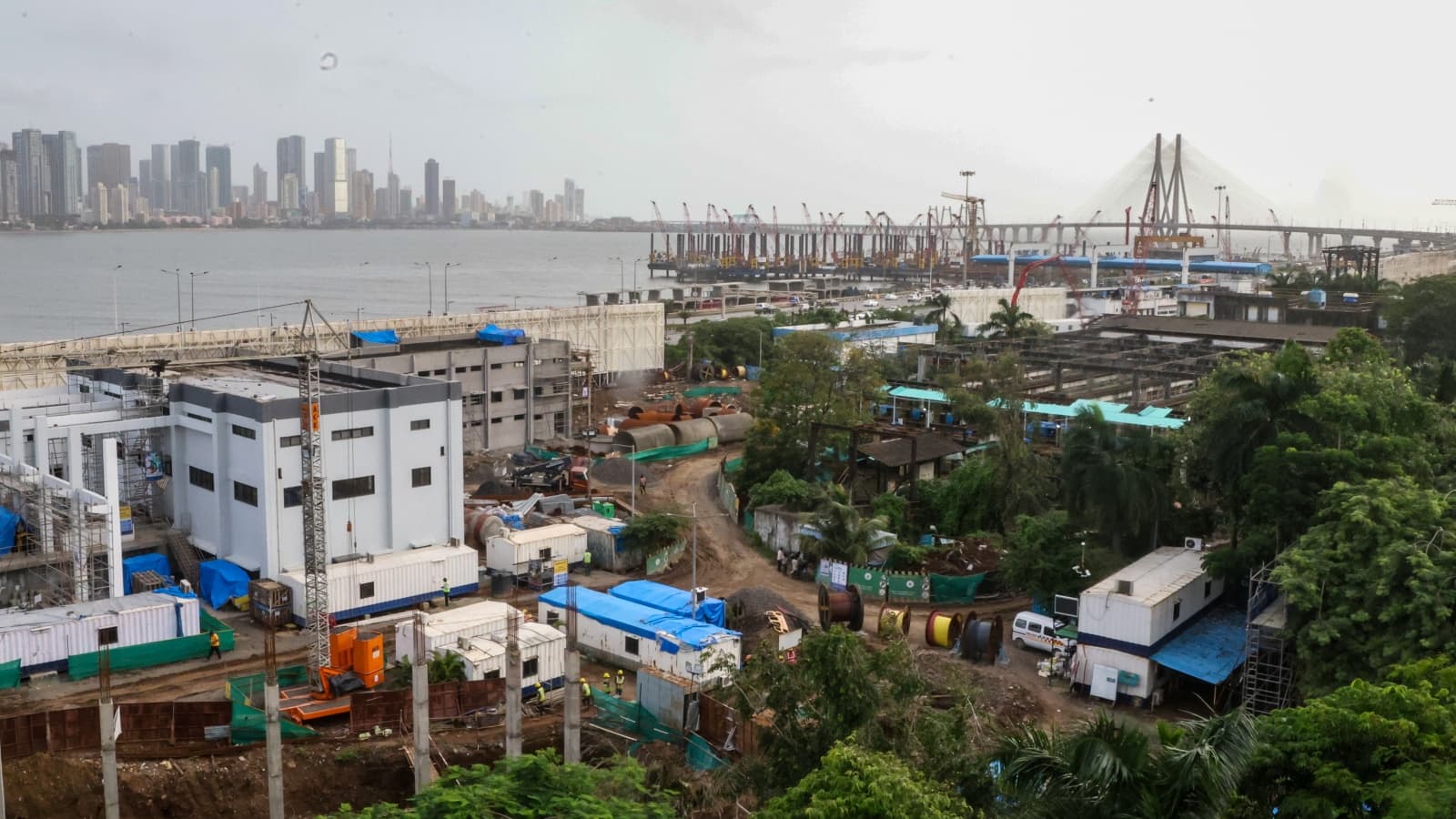
An aerial view of the under construction site where Mumbai’s newest sea-viewing deck is set to come up adjacent to the Bandra-Worli Sea Link in Bandra. (Express photo by Akash Patil)Mumbai is set to get a new sea-viewing deck by July 2027, but unlike the city’s existing waterfront promenades, this one will stand atop a sewage treatment plant. The viewing deck, currently under construction at the southern edge of Bandra adjoining the Bandra-Worli Sea Link (BWSL), is part of the Brihanmumbai Municipal Corporation’s ambitious Wastewater Treatment Facility (WWTF) project. Along with the viewing deck, the project will create 2.6 acres of landscaped public open space with gardens, walkways, seating areas and outdoor gym equipment — a significant addition in space-starved Mumbai.The proposed facility will be the first dedicated sea-viewing deck in Mumbai’s suburban belt. At present, the city has two such decks, at Dadar and Girgaon. The additional open space will be nearly twice the size of an average football ground and more than twice the size of the Cooperage Ground in Churchgate. The viewing deck, knowledge centre and landscaped public space are estimated to cost Rs 67 crore.The Bandra project is one of seven sewage treatment plants (STPs) the BMC is constructing under its Rs 30,000-crore WWTF project, launched in 2023. The other plants are coming up at Worli, Dharavi, Ghatkopar, Bhandup, Versova and Malad. Scheduled to become operational in phases between the end of 2026 and 2027, the seven facilities will have a combined capacity to treat and recycle 2,400 million litres of wastewater a day — equivalent to around 55 per cent of Mumbai’s daily water requirement. According to civic officials, the auditorium and convention hall will include a modern library, digital classrooms, auditorium-style seating and digitally integrated study desks.The project aims to scientifically treat Mumbai’s daily sewage, much of which is currently discharged into the sea and other natural water bodies, and make it fit for tertiary and industrial use. At Bandra, the STP will be equipped with a bioreactor unit where the primary treatment of sewage will take place. Since the facility is being developed as a multi-level structure, the basement of the reactor will be located at least 10 metres below ground level. This design allows the terrace of the reactor, at ground level, to be converted into nearly two acres of landscaped recreational space. According to the project blueprint, the landscaped area will be connected to the viewing deck through a skywalk, allowing visitors to move between the two spaces. Story continues below this ad The Bandra facility will also include a 60-metre-high tower adjoining the recreational area. The ground, first and second floors will house an auditorium, convention hall and information centre that will showcase Mumbai’s history of water conservation and the BMC’s engineering and civic infrastructure projects. “The WWTF project is a unique venture of the BMC and today engineering students from reputed educational institutions are carrying out field visits at our sites. Therefore, the BMC decided to create a knowledge centre at this site about these STPs,” a civic official told The Indian Express. According to civic officials, the auditorium and convention hall will include a modern library, digital classrooms, auditorium-style seating and digitally integrated study desks. The top floor of the tower will house the sea-viewing deck, offering an unhindered view of Mumbai’s skyline and the Arabian Sea. Visitors will be able to access the landscaped gardens and then reach the viewing deck via the skywalk.Story continues below this ad The viewing deck, knowledge centre and landscaped public space are estimated to cost Rs 67 crore. Pratip Acharya is a seasoned journalist based in Mumbai reporting for The Indian Express. With a career spanning over a decade, his work demonstrates stron
Tucked into Horniman Circle in Fort is Cafe Nur, only a year old, but already known for its juicy mutton and chicken seekh kebabs and its Mughlai spread. Go post sunset, once the working crowd that fills this neighbourhood by day has headed home, and the street settles into something closer to another era. Surrounded by the Neoclassical and Victorian-Gothic buildings that define this pocket of the city, Cafe Nur sits inside the historic Botawala Building.Dhool Design Studio has turned a 156-year-old arched shopfront into a neighbourhood of its own, spilling across three premises and the alley connecting them. On the walls are graffiti depicting Bombay — a taxi being hailed outside the Taj in the rain, a local train pulling in, the Gateway, a cobbler bent over his last. Past them are three rooms, each with its own design language but a shared old-world restraint. You are soaking it all in by the time you’re seated. Pro tip: Book ahead, by phone or on Zomato. Express Photo by Akash PatilThe place is owned and run by first-time restaurateurs Saud Hussain and Rahil Khan. “My partner Rahil is a true foodie, and I also love desi food. However, every new place seemed to be serving matcha or coffee but not Mughlai cuisine that we personally enjoyed. So we thought of bringing the food that we grew up eating to a restaurant,” said Hussain, who previously had a candy manufacturing unit in Ethiopia, adding that they were behind this location for nearly three years. “We picked it because it is a historical location. Other areas, whether Bandra or Lower Parel, more or less look the same. It is Fort that retains the old history, old memories of Bombay. Our food is something like that.” The menu is only a single page featuring signature kebabs and rolls, Nur dum biryani (available in mutton and chicken), nihari, keema, dal ghost, mutton rosh, nalli barra, chai, coffee, bun maska, malai parantha, tandoori roti, and a khimri naan baked soft with a light polish of ghee, perfect to mop up every bit of the gravy. To drink, there’s a gud sherbat that leans sweet, a litchi rose sherbat where the litchi wins out, and the usual sodas. For dessert: phirni, sewaiyan, kulfi, Pashtun halwa. Express Photo by Akash PatilWe went to send off a colleague and ordered fairly widely. The mutton and chicken seekh kebabs were soft and juicy; the chicken malai tikka was well-flavoured too. The nihari didn’t have the spice or the layering you would find at a dedicated nihari joint, but the mutton was cooked through and the gravy did its job soaking into the khimiri roti. The mutton rosh, made with white chana, had a nice bit of crunch from the birista on top — dal-like in texture, and seasoned the way it would be at home rather than in a restaurant. “The entire menu is oil-free, we use only ghee,” said Hussain, adding that most dishes are made using home recipes. “There is my nani’s slow-cooked nihari, and dal ghost made using three kinds of dals. It was a staple at home every Friday, post prayer. Unlike restaurants, it is not very heavy, and is mildly spiced. There’s Rahil’s mother-in-law’s Nur Special Biryani made during Ramzan. It is a yakhni-like preparation that has dum rice and plain rice, and uses dahi and malai both.” The food, they insist, is not overtly spiced or made heavy. “We don’t want guest to feel that they are eating restaurant food with a lot of masala, we wanted to keep it as homely as possible.”Story continues below this ad Express Photo by Akash PatilThe menu is also intentionally kept smaller so that they can give their hundred per cent to every dish. On the vegetarian side — and this is not really a vegetarian menu — the paneer tikka was let down by paneer that was hard and chewy, though the paneer in the paneer tikka gravy was much better. Aatishi aloo was well spiced, and the dal khichdi, finished with ghee and birista, was simple and wholesome. A biryani for non-meat eaters would have been welcome. It is a request they get often. “People


Discussion (0)