
Loading dispatches...
← Return to NewsroomScience
Private companies could ruin the night sky for the entire world, and international law can't stop them
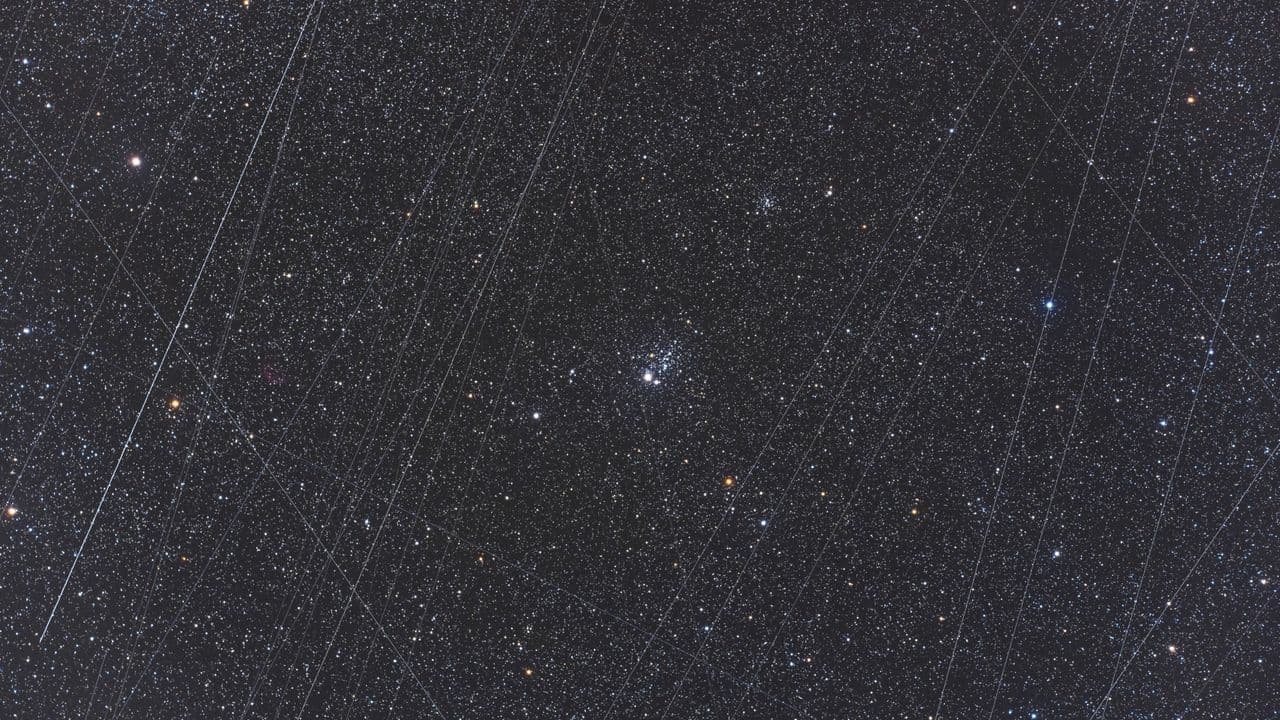
Satellite trails in front of NGC 457, or the Owl Cluster. (S. Federal Communications Commission (FCC) can single-handedly green-light massive spaceflight projects that could completely change the view of the night sky for the entire world. Despite the outcry these projects have caused, space law experts say there is very little other nations and the international community can do to thwart them if the FCC were to grant them licenses.On July 10, the FCC approved an application by California-based Reflect Orbital to launch a 59-by-59-foot (18-by-18 meters) space mirror to test how to reflect sunlight onto solar farms on Earth after dusk. The decision has sparked outcry among astronomers and environmentalists who are concerned about the impact on global light pollution levels that Reflect Orbital's plans might have.Opponents see the FCC's approval, despite hundreds of objections filed in response to the application, as an indication that the agency might eventually grant Reflect Orbital a license to fly an entire constellation of 50,000 such sun-reflecting mirrors. On top of Reflect Orbital's plans, companies including SpaceX, Blue Origin and Starcloud are awaiting the FCC's decisions on respective applications to deploy their own massive fleets of orbiting data centers and internet-beaming satellites. If all those projects come to fruition, the view of the night sky could change beyond recognition all over the world."The technology is outpacing the regulatory environment."The United Nations' Outer Space Treaty conceived in the late 1960s lays down the international framework for the use and exploration of outer space. The document states that approvals for satellite projects are the domain of the nation in which those satellites are registered."The U.N. Treaty for Uses of Outer Space very well specifies that how many satellites are shot into space and how they are registered is a prerogative of the country in which they are registered," a source familiar with the operations of the United Nations Office of Outer Space Affairs (UNOOSA), who didn't wish to be named, told Space.com.The states from which they launch, however, are responsible for any damage the satellites registered under their flags cause to other countries. But Ruskin Hartley, the CEO and Executive Director of the advocacy group DarkSky International, told Space.com that this liability provision only covers physical damage such as satellites colliding in space or spacecraft crashing down on Earth and damaging property."It hasn't been tested at all but most people don't think this damage extends to optical interference," Hartley said. "It would have to be physical damage. If a satellite reflects sunlight down and damages someone's observatory, that probably doesn't count as damage under the Outer Space Treaty."In its Article I, the Outer Space Treaty states that "the exploration and use of outer space, including the moon and other celestial bodies, shall be carried out for the benefit and in the interests of all countries." But what exactly that means and what could be done if there is no consensus about those benefits is not clear at all.The anonymous source told Space.com that UNOOSA and the UN-wide Committee on the Peaceful Uses of Outer Space (COPUOS) may discuss the issue, but despite the global consequences, are unlikely to come up with a mechanism to stop the corporations from doing what they want if the FCC backs them."These UN institutions were all started in the last century and are very slow," the source said. "They require unanimous consensus to pass anything and that obviously hardly ever happens. So nothing gets passed. By the time UN COPUOS and UNOOSA are done discussing anything, SpaceX will have launched another thousands satellites." A rendering of Reflect Orbital's proposed constellation of mirror satellites. (
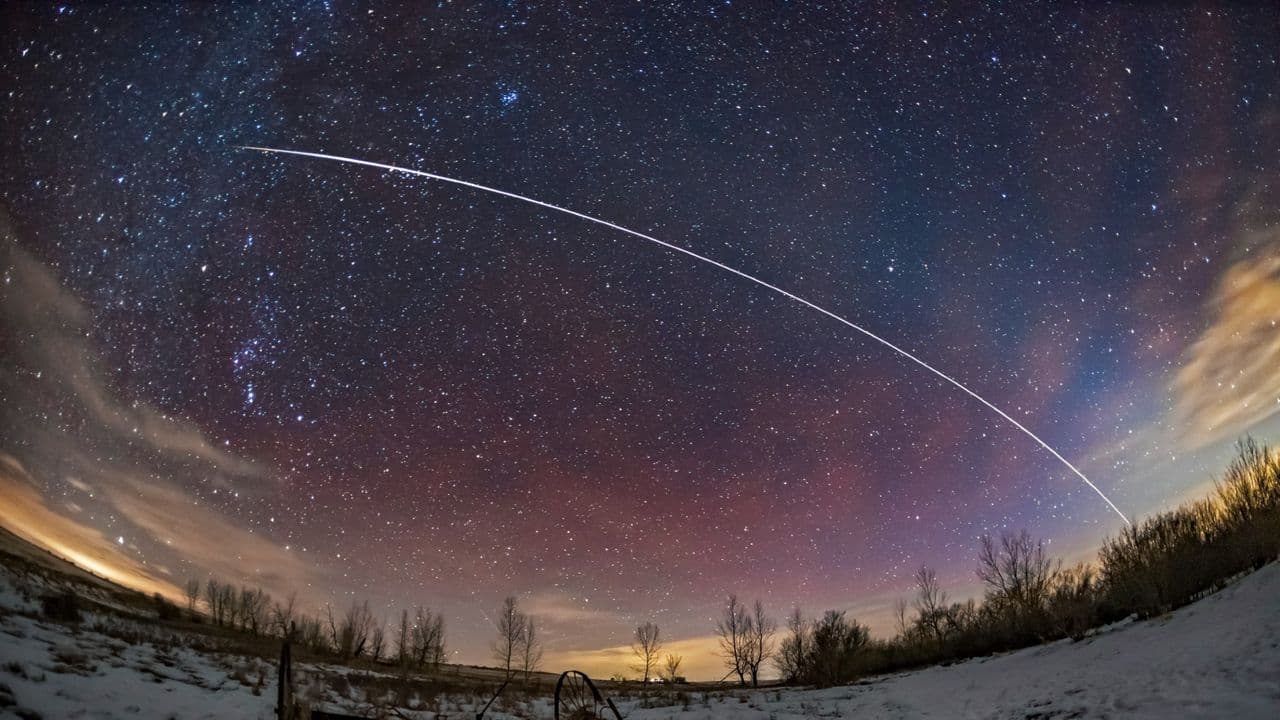
Astronomers warn that large satellite constellations planned by several private companies could have a catastrophic impact on the night sky. A pass of the International Space Station is seen here. ( This ring, traversing the sky for hours after dusk and before dawn, would outshine every star and planet, and be visible from every spot on Earth.Hugh Lewis, a professor of astronautics at the University of Birmingham in, the U.K., told Space.com that the only way to accommodate the high number of data center constellations that have been proposed is to stack them above another in orbit above the boundary between day and night, creating an artificial "Saturn's Ring" of satellites around the planet. That ring would show in the sky as a luminous band much brighter than any star or planet and even the full moon."If you were to look up at night, they would be all in one plane, really close together, going in the same direction," said Lewis. "The impact on the night sky would be absolutely catastrophic."The next time you're away from urban light pollution, spend some time outdoors after dark and enjoy the view of the Milky Way and the constellations that have inspired awe since humankind woke to consciousness. Chances are those views are not here to stay forever.Such a notion would have seemed like science fiction only a few years ago, but since the orbital data center frenzy kicked off last year, the once-fanciful prospect has become a distinct possibility.A flurry of companies including SpaceX, Starcloud, Cowboy Space, Orbital and Blue Origin have applied to the U.S. Federal Communications Commission (FCC) for licenses to launch more than a million data center satellites combined. China has already jumped on that bandwagon, too, with plans to develop an orbital data center network within the next five years.On top of those projects, California-based Reflect Orbital wants to launch 50,000 orbiting mirrors into space to reflect sunlight to solar power plants on Earth after dusk. Reflect Orbital received its license from the Federal Communications Commission (FCC) on Friday, July 10, to fly the first of these mirrors — a 60 by 60 feet (18 by 18 meter) demonstration satellite named Eärendil-1, which is expected to launch by the end of this year. A rendering of Reflect Orbital's proposed constellation of mirror satellites. ( This orbital plane follows the terminator line — the boundary between day and night — and takes the satellites over the planet's north and south poles."Orbital data centers and Reflect Orbital all tend to rely upon what these operators call 24 hours of sunlight in space," Lewis said. "To have that, you have to be in a particular orbit, which follows the dawn-dusk line. It's not like the Starlink megaconstellation, which is distributed around the Earth." A view of Earth taken by an Artemis II astronaut from one of the Orion spacecraft's four windows after completing the mission's translunar injection burn on April 2, 2026. ( Lawler and her colleagues used computer modelling to visualize the impact of several of the proposed data center fleets including SpaceX's Starmind, Blue Origin's Project Sunrise and the Stampede constellation proposed by Cowboy Space.In those visualizations, satellites visible from the planet's surface not just outshine the visible stars, they also outnumber them. Lawler explained that as Earth turns under the terminator orbit, the Saturn's ring of satelli
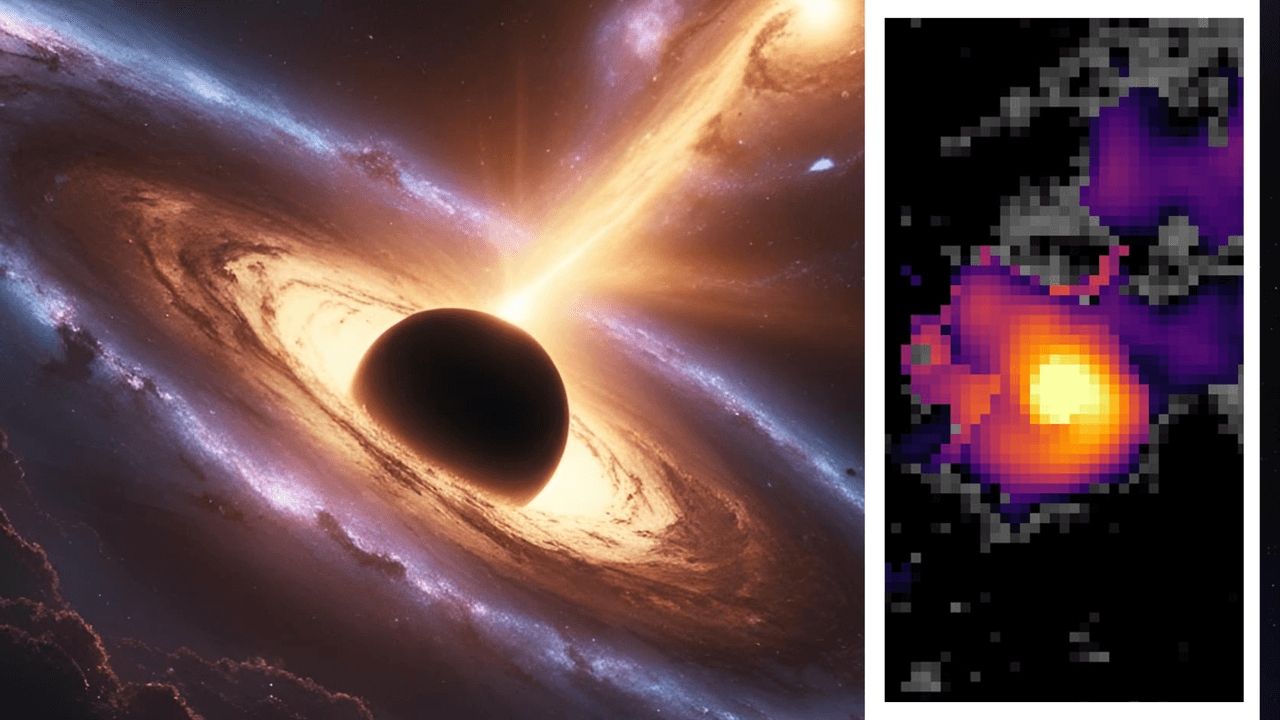
(Main) An illustration of a feeding supermassive black hole (Inset) the heart of the galaxy NGC4696 in a combined view from the JWST and Hubble. ( Hlavacek-Larrondo, et al. 2026) Thanks to the James Webb Space Telescope (JWST), astronomers have been given a glimpse of the mechanisms that supermassive black holes use to feed themselves. The observations could help scientists discover how supermassive black holes with masses millions, often even billions, of times that of the sun grew so fast so soon after the Big Bang.While all large galaxies have supermassive black holes at their hearts, some are slumbering giants, consuming little surrounding gas and dust, while others are ravenously feeding and acting as the engines of bright central galactic regions called active galactic nuclei (AGN). These feeding black holes also blast matter from their poles in jets that can drive gas and dust — the raw material needed for star formation — out of their host galaxies, thus cutting off star birth and effectively "killing" these galaxies.Plus, the powerful cosmic titans get really puzzling when astronomers using the JWST spot them before the universe was even 1 billion years old. That's because the mechanisms by which black holes devour matter to grow and then merge to create even more massive black holes should take at least 1 billion years to achieve supermassive status. This is even more confusing because theories also say the most ravenously feeding black holes (and thus the fastest growing) should also push the matter they use for this growth away, in effect putting themselves on a diet. So, with all this in mind, how did supermassive black holes grow so rapidly in the early universe?One explanation suggests supermassive black holes push away gas, starving themselves as predicted, but also that this matter eventually cools and falls back to the black hole. That would allow for another period of feeding and thus growth.This explanation further suggests that as this gas cools down, it forms "streamers," or filaments, of gas just a few hundred light-years wide but which stretch thousands of light-years long. These would fall back to the center of the galaxy and form a swirling disk around its incumbent black hole, once again feeding it and triggering a new period of growth. This would then restart the jets from the black hole, which would again cut off the cosmic titan's food supply, allowing the whole process to begin once more.The process would in essence be a self-regulating cycle of feasting followed by fasting. However, the connection between these filaments and supermassive black holes has been elusive, meaning this mechanism has resisted confirmation."What JWST is revealing is that black holes may be the ultimate cosmic recyclers," team leader Julie Hlavacek-Larrondo of the Université de Montréal said in a statement. "They release enormous amounts of energy that heat their surroundings, yet that same gas can later cool into thin filaments that fall back inward and feed the black hole again. We are finally seeing this self-sustaining cycle in action."A dieting supermassive black holeTo solve the mystery of feasting black holes, the JWST turned its attention to a relatively close AGN situated at the heart of the central galaxy of the Centaurus Cluster, NGC 4696, located just 145 million light-years from Earth.The Hubble Space Telescope previously studied this galaxy, uncovering a strange, hook-shaped swirl of gas near the central supermassive black hole of NGC 4696.The JWST followed up this discovery by producing a detailed map of gas flowing at the heart of the galaxy. This revealed the hook-shaped feature is around 800 light-years wide and is composed of gas moving at incredible speeds of around 1.3 million miles per hour (600 kilometers per second).More excitingly, the swirl of gas appears to be connected to a vast filament of material falling in toward the central supermassive blac
The Gemini South Observatory shoots out a beam of light. ( Horálek)A laser star guide beams up from the Gemini South Observatory and into the Milky Way on Cerro Pachón, a mountain in central Chile.What is it? The Gemini South Observatory, located in Chile, is one of two Gemini Observatories with the other located in Hawaii (named Gemini North, or 'Alopeke) on the volcano Mauna Kea.Each Gemini Observatory has a 26.6-foot (8.1-meter) telescope. On the same mountain in Chile sits the 13.4-foot (4.1-meter) SOAR telescope.In this photograph captured by Petr Horálek, an audiovisual ambassador for the U.S. national center for ground-based, nighttime optical astronomy at NOIRLab (the National Optical-Infrared Astronomy Research Laboratory), it looks like Gemini South is about to be beamed up into the night sky.However, there isn't some alien ship behind that laser beam. Instead, Gemini South is beaming up a laser guide star, or a powerful laser that creates the appearance of a fake star in the night sky. This fake star acts as a reference point, helping the telescope to calibrate and correct any light distortions.Why is it incredible? Even from just this photograph, which shows an observatory in action, it's clear why this mountain is a hotspot for astronomical observing.These peaks are chosen for many reasons, including their altitude and how far they are from bright lights that could affect observations. But even in a regular photograph, Horálek was able to show the incredible beauty of the glow of the Milky Way's heart above the mountain range, with every color in the rainbow popping up in the gas and dust across our galaxy.Even the framing of the shot draws you in, as the viewer feels almost pulled down the road toward the observatory and right up into the Milky Way. Chelsea Gohd served as a Senior Writer for Space.com from 2018 to 2022 before returning in 2026, covering everything from climate change to planetary science and human spaceflight in both articles and on-camera in videos. With a M.S. in Biology, Chelsea has written and worked for institutions including NASA JPL, the American Museum of Natural History, Scientific American, Discover Magazine Blog, Astronomy Magazine, and Live Science. When not writing, editing or filming something space-y, Gohd is writing music and performing as Foxanne, even launching a song to space in 2021 with Inspiration4. You can follow her online @chelsea.gohd and @foxanne.music
Discussion (0)