
Loading dispatches...
← Return to NewsroomScience
A 'river' of cosmic gas 1 trillion miles long sent planets in the Orion constellation into tilted orbits
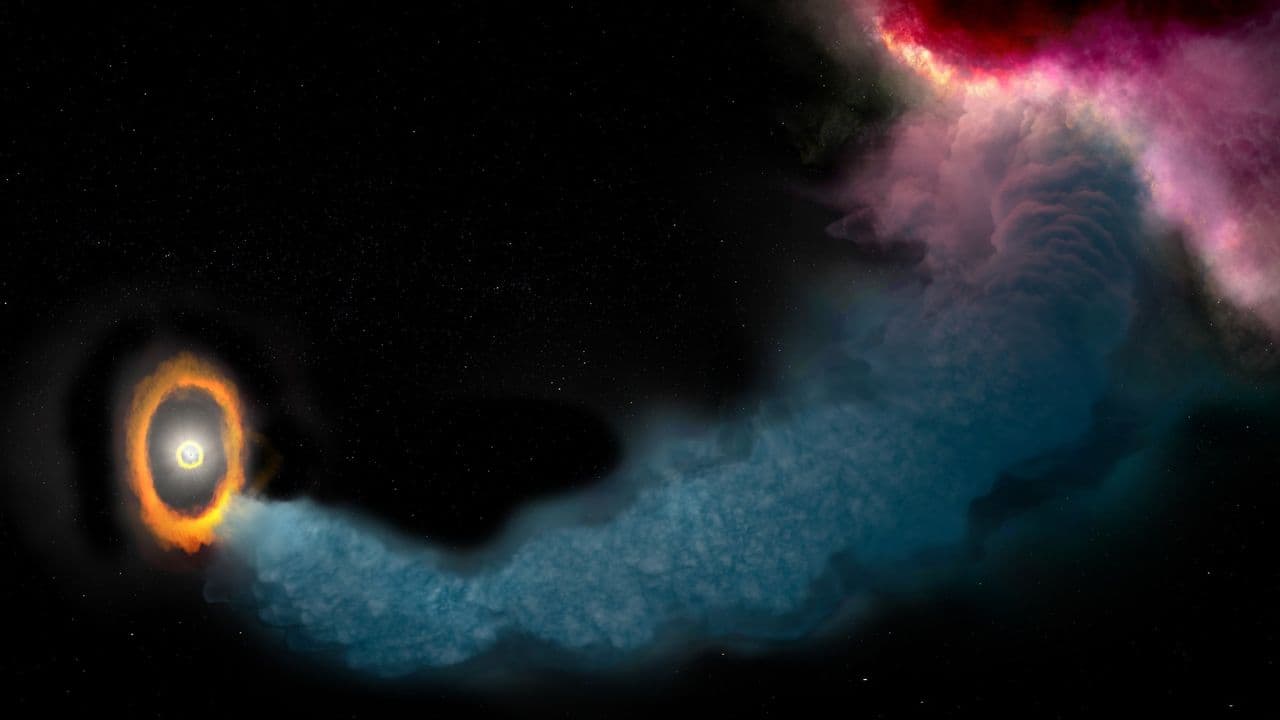
This artist's representation highlights the streamer feeding material onto the protoplanetary disk, GW Ori, creating misaligned dust rings. (Saxton) A rare planet-forming disk around a young triple-star system in the Orion constellation has been tipped over by a river of gas over 1 trillion miles (1.6 trillion kilometers) long. The discovery, made at radio wavelengths with ALMA, the Atacama Large Millimeter/submillimeter Array in Chile, could explain why astronomers keep finding planets with orbits that are drastically misaligned with the rotational axes of their stars.GW Orionis is a triple system consisting of three pre-main sequence stars, meaning that they are still forming and contracting and have not yet initiated fusion reactions of hydrogen in their core. The stars are located roughly 1,300 light-years away, in the Lambda Orionis star-forming molecular ring in the constellation of Orion, the Hunter. Finding a planet-forming disk of gas and dust encircling all three stars in a system is very rare, and finding a disk consisting of three rings with misaligned orbits is even stranger."Previous studies of GW Orionis revealed that the system's inner, middle and outer rings are misaligned, with each ring tilted at a different angle," said Maria Galloway-Sprietsma, a PhD student at the University of Florida who led the research, in a statement.The outer ring, which is one of the largest ever seen around a young star, is the most noticeably misaligned. It had previously been thought that an unseen gas giant planet, having carved out a gap between the middle and outer ring, was perturbing the outer ring.Now though, Galloway-Sprietsma and colleagues have discovered the hidden truth: an enormous finger of gas reaching in from the surrounding molecular cloud is disturbing the outer ring, and the exchange of angular momentum, or rotational energy, between the two is warping the ring and tipping it over.The disk around GW Orionis is composed of three rings, beginning at radii of 4.1, 17.4 and 31.6 billion miles (6.7, 28 and 51 billion kilometers/44, 187 and 340 astronomical units) from the center of the tight triple system.The streamer of gas tilting the system's outer ring was discovered through new ALMA observations. Such streamers are thought to be how stars grow, delivering mass onto nascent suns. The streamer is composed mostly of molecular hydrogen, but since molecular hydrogen is invisible at radio wavelengths, ALMA searched for molecules of carbon monoxide in the streamer instead.The length of the streamer is astounding, stretching 0.2 light years (12,600 astronomical units, 1.9 trillion kilometers or 1.2 trillion miles)."When our team modeled the infall of this streamer, we found that the angle at which it impacts the disk is closely aligned with the outer ring," said Galloway-Sprietsma. This superimposed image of of the GW Orionis star system shows images from the ALMA radio telescope (in blue) overlayed on the ESO Very Large Telescope's SPHERE instrument's view, which shows the shadow of the system's innermost ring. (, ALMA (ESO/NAOJ/NRAO))It is believed that the streamer has already done most of the work in tipping over the outer ring of the disk. Today, its angular momentum, or spin, is less than that of the disk."In the past it likely had a greater angular momentum, and that allowed the disk to become misaligned," said Bae.The discovery of the streamer might put to bed more than just the mystery of what tipped over GW Orionis' disk.In our solar system, all the planets orbit around the sun in the ecliptic plane, which is a narrow plane aligned with the sun's equator and direction of rotation. Most exoplanets orbit their star in similar fashion, but astronomers have also previously discovered some planets that have highly inclined or even retrograde orbits around their star, as though some mighty force had tipped their orbits over. With the discovery
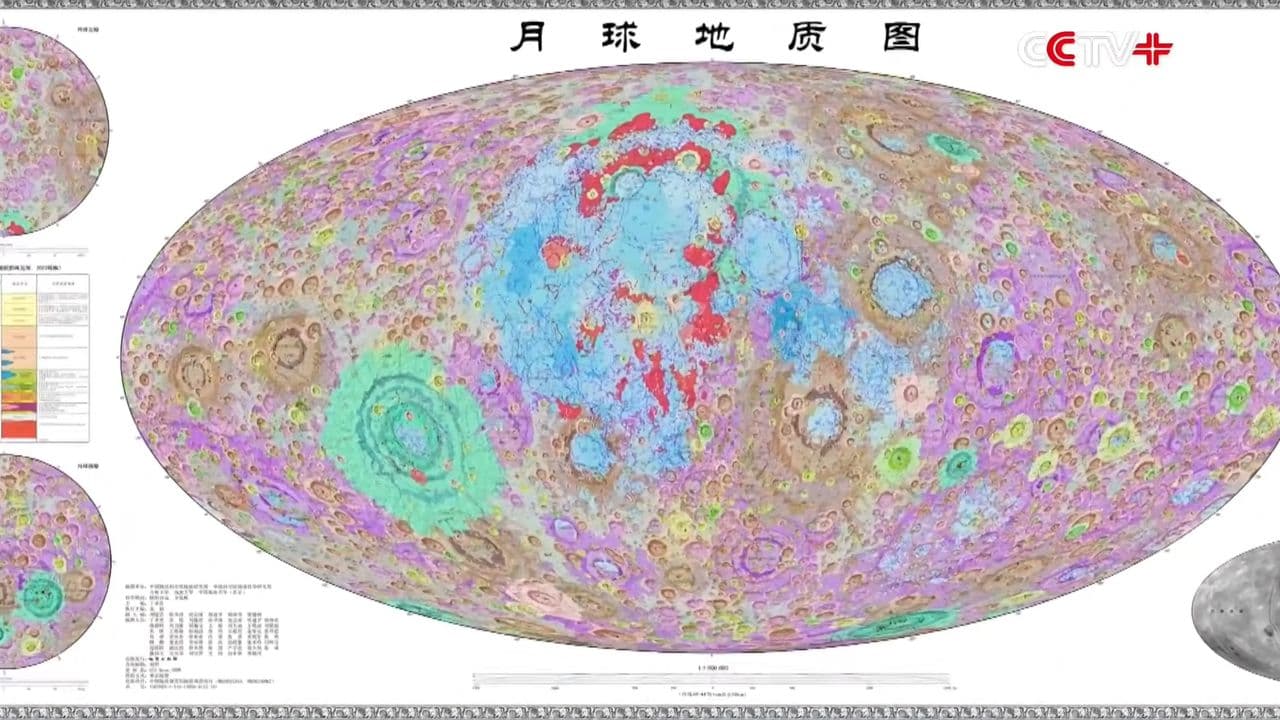
Chinese researchers have presented a new map of the moon, updating a previous edition based on new scientific findings and recalibrating the moon's ancient geologic eras.The comprehensive map of the moon, with a scale of 1:5 million, was unveiled by the Institute of Geology, Chinese Academy of Geological Sciences (IGCAGS) on Aug. 6. The map is an update of a 2024 edition and puts forward new boundaries for the ancient Aitkenian, Nectarian and Imbrian lunar periods. (The researchers use the term Aitkenian, whereas the term pre-Nectarian is often used to describe the lunar geologic period from roughly around 4.5 billion to 3.9 billion years ago.)The map also uses reprocessed spectral data to update areas of KREEP terrane, which features crustal material enriched in potassium (K), rare-earth elements (REE), and phosphorus (P), and is found to be more continuous and abundant than previously estimated. Chinese researchers released a super-detailed new map of the moon on Aug. 6, 2026. (Both the United States, through the Apollo missions, and the Soviet Union delivered lunar samples to Earth more than 50 years ago, greatly shaping research on and understanding of the moon. China's own robotic sample return missions, Chang'e 5 and Chang'e 6, launched in 2020 and 2024, respectively, have provided fresh materials and new insights.Chang'e 6 was the first sample-return mission to the lunar far side. Chinese researchers say the returned material will provide a new starting point for scientific discussions on the nature of that hemisphere of the moon, which is hidden from view on Earth.The map "introduces a proprietary cartographic standard," according to Xinhua, amid a wider, Chinese government-driven initiative to influence global standards. In terms of space, aspects of the map such as the color scheme, geologic logic and an aesthetic "lighter for younger, darker for older" principle will be applied more broadly as China looks to expand its exploration beyond the moon and into the outer solar system."This goes beyond showcasing technological soft power. This standard will be extended to future planetary geologic mapping, establishing an independent intellectual property framework for China's deep space exploration," Yang said.Both China and the United States have interests in setting standards as humanity renews its interest in exploring the moon. While on Earth everyone agrees on Coordinated Universal Time (UTC), the two countries currently disagree about what time it is on the moon, where clocks run faster due to weaker gravity. This suggests that leadership in space will be contested not just through missions and firsts, but via whose technical standards are followed, with China's new map playing into these efforts. Andrew is a freelance space journalist with a focus on reporting on China's rapidly growing space sector. He began writing for Space.com in 2019 and writes for SpaceNews, IEEE Spectrum, National Geographic, Sky & Telescope, New Scientist and others. Andrew first caught the space bug when, as a youngster, he saw Voyager images of other worlds in our solar system for the first time. Away from space, Andrew enjoys trail running in the forests of Finland. You can follow him on Twitter @AJ_FI.
(This animated space opera, a French/Japanese co-production, delivered a crash course in Greek mythology to a generation of kids who grew up in the '80s. And, although it looks more like "Star Wars" than Homer's original tale, it had a decent stab at transferring the Classics to the 31st century (the clue really was in the title), years before the Coen brothers took "The Odyssey" to the Deep South in "O Brother, Where Art Thou?"The cartoon's core premise would be familiar to any Greek scholar, even though purists would surely bristle at the hero going under his Roman pseudonym, Ulysses, rather than the original Greek Odysseus. ( That voyage is soon waylaid, however, when Ulysses' son, Telemachus, is abducted to become a sacrifice to a giant robot Cyclops.Ulysses quickly lives up to the promise of his famous theme song — "Always fighting all the evil forces, bringing peace and justice to all" — by vanquishing the one-eyed menace and rescuing Telemachus along with Yumi and Numinor (a pair of blue alien Zotrians who, as far as we can tell, do not feature in the original Homer).Unfortunately for Ulysses and his crew, he messed with the wrong giant robot Cyclops, because this one happened to belong to the Greek sea god Poseidon, who's now taken up residence in outer space. The deity is so annoyed at the puny mortal's impudence that he gets his brother, Zeus (aka the head honcho in Olympus), to inflict divine retribution. ( If he's going to make it home to Penelope, he'll need to find the Kingdom of Hades before his 26-episode run comes to an end.It's less an update of Homer than a riff on his greatest hits, with several other notable classics of the Classical period thrown in for good measure. In addition to slaying the Cyclops, Ulysses follows in OG Odysseus's footsteps when he meets the Sirens and Lotus Eaters.But he also ventures beyond the confines of Homer's narrative when he encounters Sisyphus (fated to devote his entire life to a repetitive, pointless task), Orpheus (en route to Hades to rescue Eurydice, the love of his life), and three-headed dog Cerberus, reinvented as an interceptor satellite with, yes, three heads. ( Priam, the commander of the Troy starbase, shares his name with Troy's last king in antiquity, while Nestor, Ulysses' second in command, is an advisor in the original story. Shirka, the computer on Ulysses' ship, takes her name from Circe, a sorceress.But the show also adopts a pretty liberal approach to the source material. Homer's version of Telemachus spends much of the story separated from his dad, whereas "Ulysses 31"'s is a constant presence. While Odysseus's shipmates mostly wound up dead, here they're plunged into a state of literal suspended animation, lifelessly floating in the ship's hold.And Ulysses is already aware of the Greek gods before he makes first contact — in one episode, he even travels back thousands of years in time to meet his famous namesake. (
Discussion (0)