
Loading dispatches...
← Return to NewsroomScience
The Andromeda galaxy may be getting bullied by a smaller galactic neighbor, scientists find
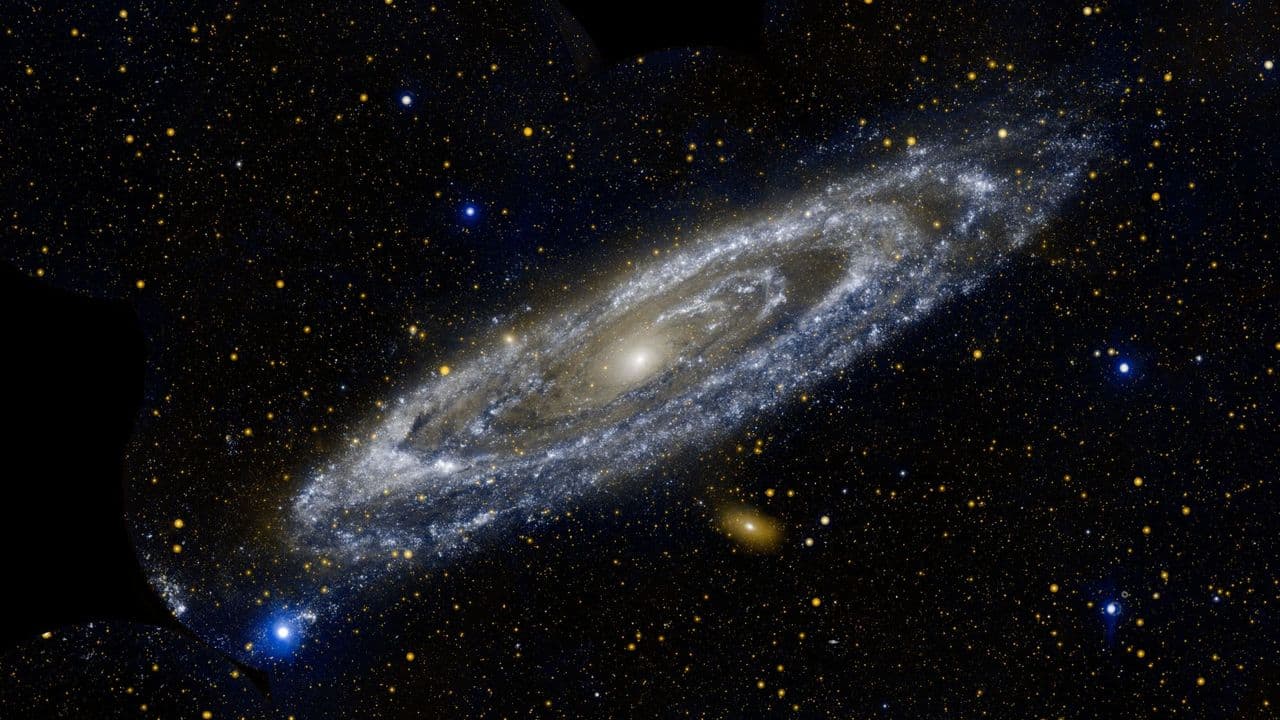
An image from NASA's Galaxy Evolution Explorer, showing the ultraviolet side of the Andromeda galaxy. (Using Hubble Space Telescope observations of Andromeda's stars, a research team showed that the spiral galaxy's rate of making new stars has dramatically slowed down in the last 40 million years. And they've found more evidence that one of Andromeda's own neighbors — a smaller galaxy called M32 — may be to blame."We can't explicitly say that we are seeing a decrease in star formation because of M32. But it's right there, and it's definitely the most likely suspect," said Tobin Wainer, a graduate student at the University of Washington and one of the astronomers, in a statement.Astronomers like Wainer knew from prior research that Andromeda saw a burst of star formation about 2 billion years ago (possibly as a result of a collision with an unknown galaxy). They also knew that star formation had slowed down since then. What they did not know was how quickly that deceleration had been. If they could find out, they could fill in some of the gaps in Andromeda's history.At 2.5 million light-years' distance, Andromeda is near enough to Earth that Hubble can measure its stars. In the past several years, Hubble has conducted two surveys of Andromeda. While Hubble can only make out stars in Andromeda that are brighter than our sun, these two surveys still gave Wainer and colleagues a compendium of 200 million stars, covering two-thirds of Andromeda's disk.Wainer and colleagues parceled out this vast space into a grid of squares, 300 light-years to a side. They reconstructed the history of each square by examining the colors of its stars.A square with many bright blue stars, for example, probably saw a lot of star formation recently, since blue stars tend to be younger. On the other hand, if a square only contains smaller, redder stars, we know those stars are longer-lived and older, and that square probably hasn't seen a lot of newborn stars.The astronomers mapped out a story of slowing star formation. Around 500 million years ago, on average, Andromeda turned the equivalent of our sun's mass in gas and dust into newborn stars each year. As millions of years passed, that rate declined. About 40 million years ago, it was about one-half the sun's mass each year. Then, it tilted into a dramatic deceleration. Today, it stands at about one-fifth the sun's mass each year. The Andromeda galaxy, M31, with satellite galaxies M32 (center left) and M110 (lower right). ( Ozime)Curiously, they found that Andromeda's starmaking slowdown is especially pronounced on one particular side of the galaxy, starting about 60 million years ago. Astronomers know this side of Andromeda is closest to another galaxy: M32.Astronomers have eyed M32 with suspicion for some time now. M32 is only located about 16,000 light-years from Andromeda (Andromeda is formally called M31) and it looks like the rump core of a spiral galaxy that lost its arms. It's possible that this is actually the aftermath of a collision between M32 and its larger neighbor. It's possible, though not confirmed, that Andromeda's slowing bears the fingerprints of this collision.We may not need to wait long for more answers. Just as Hubble can see Andromeda's stars, so too will the Nancy Grace Roman Space Telescope, set to launch in late August. In the coming years, Roman will be able to measure even more of Andromeda than Hubble has. Rahul Rao is a graduate of New York University's SHERP and a freelance science writer, regularly covering physics, space, and infrastructure. His work has appeared in Gizmodo, Popular Science, Inverse, IEEE Spectrum, and Continuum. He enjoys riding trains for fun, and he has seen every surviving episode of Doctor Who. He holds a masters degree in science writing from New
Lanterns | Official Trailer | HBO Max - YouTube Watch On Trailers and teasers for HBO’s upcoming "Lanterns" series have been suspiciously devoid of much outer space footage for the intergalactic cops known as the Green Lanterns, but that's all history now with this exhilarating new preview.Beware the power of this illuminating peek that not only delivers generous doses of Hal Jordan (Kyle Chandler) mentoring his young apprentice, John Stewart (Aaron Pierre), but also tosses in cool shots above an alien planet, a prison world, and what could be barren Mars.And there's green galore via electrifying emerald constructs (including a beer opener) emanating from the cosmic peacekeepers' trusty power rings. Plus we're treated to a severe warning by the normally-wisecracking Guy Gardner (Nathan Fillion) as a serious but satisfying bonus. DC Studios' "Lanterns" soars onto HBO and HBO Max on Aug. 16, 2026. ( 16, 2026 courtesy of DC Studios and heralding from executive producers Chris Mundy, Damon Lindelof, and Tom King.From this latest trailer it's apparent that weird shape-shifting Manhunters will be primary antagonists alongside the crimson-skinned criminal Sinestro (Ulrich Thomsen) and that has piqued our interest. It delivers a well-rounded depiction of the series' story arc and motivational beats that follow an older generation of Lanterns giving way to a younger law enforcement recruit."Manhunters are the most dangerous beings to ever exist in the galaxy," Paul Ben-Victor's extraterrestrial truth-seeker, Antaan, explains. "And it can take the form of any species." Aaron Pierre (L) and Kyle Chandler (R) star as space cops in "Lanterns." (Landing from DC Studios, Warner Bros. Television, and HBO, "Lanterns" debuts Sunday, Aug. 16 at 9:00 p.m. ET/PT on HBO and later streaming on HBO Max. Jeff Spry is an award-winning screenwriter and veteran freelance journalist covering TV, movies, video games, books, and comics. His work has appeared at SYFY Wire, Inverse, Collider, Bleeding Cool and elsewhere. Jeff lives in beautiful Bend, Oregon amid the ponderosa pines, classic muscle cars, a crypt of collector horror comics, and two loyal English Setters.
Discussion (0)