
Loading dispatches...
← Return to NewsroomScience
NASA is sending 2 probes to the moon to test complex 'three-body orbits'
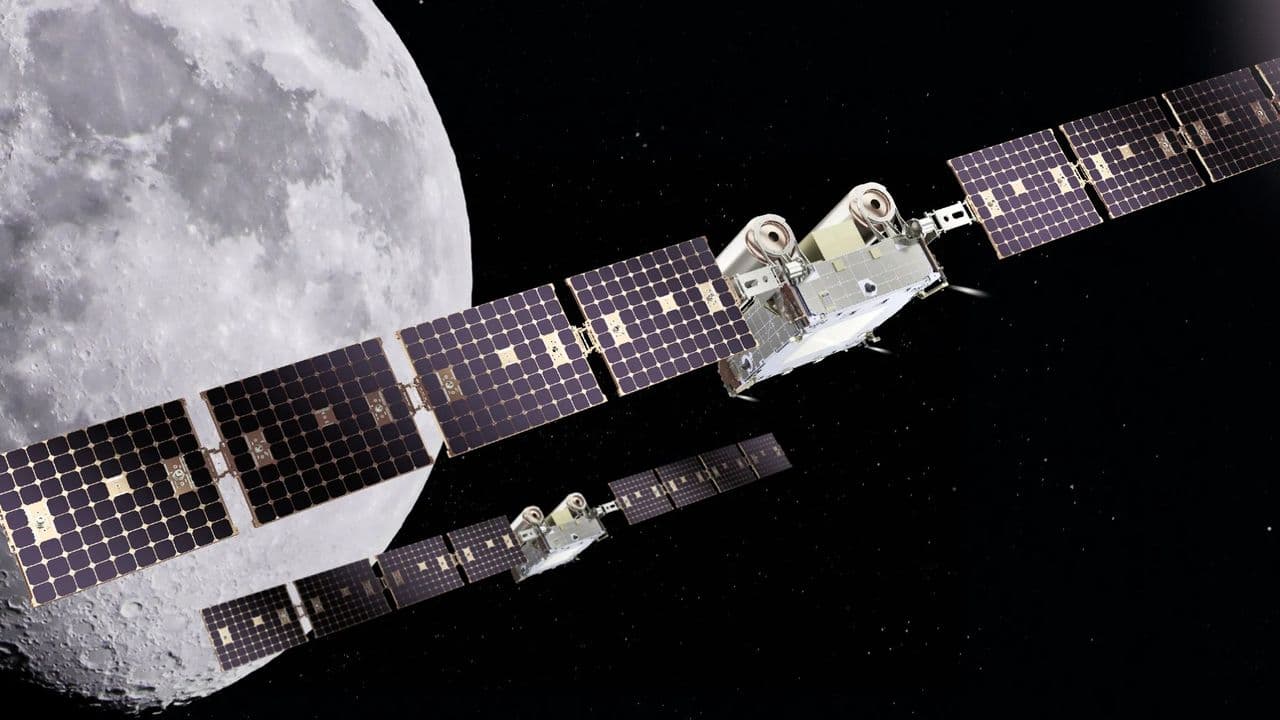
An artist's rendering of NASA's CAPSTONE 02 spacecraft in lunar orbit. (The mission, known as CAPSTONE 02, is currently aiming to launch in 2027. It will see the two probes maneuver in close proximity to one another and fly in "formation" so mission operators can better understand the gravitational effects spacecraft experience in cislunar space. This area of space is under the influence of both Earth's gravity and the moon's, meaning spacecraft operating there will have to navigate what are known as "three-body orbits."While testing spacecraft maneuverability in these complex orbits, CAPSTONE 02 will also study communication and navigation systems that will be used in NASA's planned Artemis missions of lunar exploration and moon base construction. "This mission represents an important step in the maturation of cislunar capabilities," said NASA's Sean Fuller, Moon Base CAPSTONE manager, in an agency statement. "CAPSTONE 02 lays the foundation for lunar infrastructure and commercial services that support Artemis, Moon Base, and future missions to deep space."The two CAPSTONE 02 probes are being built by Terran Orbital Systems, Inc. Once in space, they will alternate jobs while flying in formation, switching between what NASA calls "chaser" and "target" roles.The spacecraft pair will use celestial navigation, optical sensors and data collected by telescopes on the ground during these maneuvers. This is similar to how NASA will use a variety of data to help its Orion spacecraft meet up with a lunar lander en route to the moon.On the upcoming Artemis III mission, currently scheduled for 2027, NASA will test some of these techniques as Orion will rendezvous with both Blue Origin's Blue Moon lander and SpaceX's Starship, if all goes according to plan."Transporting crew to the lunar surface from cislunar orbit depends on knowing how well navigation systems will perform during these operations. Since these conditions can't be fully recreated on Earth, they must be tested in space," NASA wrote in its statement outlining the CAPSTONE 02 mission. An artist's rendering of NASA's Orion spacecraft meeting up with SpaceX's Starship on the planned Artemis III mission. ( The first CAPSTONE probe launched in 2022 and operated for four years before NASA officially concluded its mission in June 2026.That microwave-oven-sized CAPSTONE spacecraft tested communications tech and became the first spacecraft to test three-body orbits around the moon, according to a NASA statement.CAPSTONE was tested in what is known as a near rectilinear halo orbit. This is a fairly gravitationally stable orbit, thanks to the nearly equal pulls of both Earth's gravity and the moon's. Brett is curious about emerging aerospace technologies, alternative launch concepts, military space developments and uncrewed aircraft systems. Brett's work has appeared on Scientific American, The War Zone, Popular Science, the History Channel, Science Discovery and more. Brett has degrees from Clemson University and the University of North Carolina at Charlotte. In his free time, Brett enjoys skywatching throughout the dark skies of the Appalachian mountains.
A SpaceX Starship V3 rocket stands upright on a launch pad at the company's Starbase facility on May 22, 2026 in Boca Chica Beach, Texas (The proposed FAA rule, released yesterday (July 29), has a 30-day period for comment and if approved, would apply to rocket launches, re-entering spacecraft, and the sites at which launches and re-entries take place. The FAA proposes to "waive requirements of laws of the U.S. for a license or permit, after consultation with the head of the appropriate executive agency, when the requirement is not necessary to protect the public health and safety, safety of property, and national security and foreign policy interests of the United States," the text of the proposal reads, in part.The Department of Transportation stated that the proposal, if implemented, would allow the agency to waive what it calls "unnecessary environmental laws and regulations" that it claims are "slowing American innovation." However, the proposal will still require the FAA to ensure that launches do not impede on public health and safety, or U.S. national security or foreign policy.To do so, the FAA plans to remove 13 federal laws from applying to "certain commercial space licenses and permits", with examples including the National Environmental Policy Act, the Endangered Species Act, parts of the Clean Water Act, the Clean Air Act, and the National Historic Preservation Act.The proposal takes place as the United States is seeing unprecedented demand on its limited spaceports for commercial launches, fueled by broadband satellite constellations like SpaceX Starlink, as well as emergent orbital data centers. Earlier this month, the U.S. government proposed moving some launch operations offshore to ease the demand backlog. More rocket launches, according to peer-reviewed research, could cause environmental issues.The proposal also appears to build on two recent Trump administration executive orders. The first, from December 2025, saw the administration aim to redirect a wide swath of space policy — including boosting the number of rocket launches and landings. (These already were at unprecedented levels last year, mostly on the back of SpaceX.) The second one, in August, focused on streamlining launch licensing and accelerating spaceport construction. A portion of the Lower Rio Grande Valley National Wildlife Refuge. SpaceX and the U.S. government are currently negotiating a land swap for a portion of the refuge. (The groups allege this proposal would degrade the Lower Rio Grande Valley National Wildlife Refuge — from which the land is coming from — with legal implications as well, but the court has not yet ruled on a lawsuit the coalition raised in June. Elizabeth Howell (she/her), Ph.D., was a staff writer in the spaceflight channel between 2022 and 2024 specializing in Canadian space news. She was contributing writer for Space.com for 10 years from 2012 to 2024. Elizabeth's reporting includes multiple exclusives with the White House, leading world coverage about a lost-and-found space tomato on the International Space Station, witnessing five human spaceflight launches on two continents, flying parabolic, working inside a spacesuit, and participating in a simulated Mars mission. Her latest book, "Why Am I Taller?" (ECW Press, 2022) is co-written with astronaut Dave Williams.
Discussion (0)