
Loading dispatches...
← Return to NewsroomScience
See gorgeous views of the Aug. 12 total solar eclipse captured from space
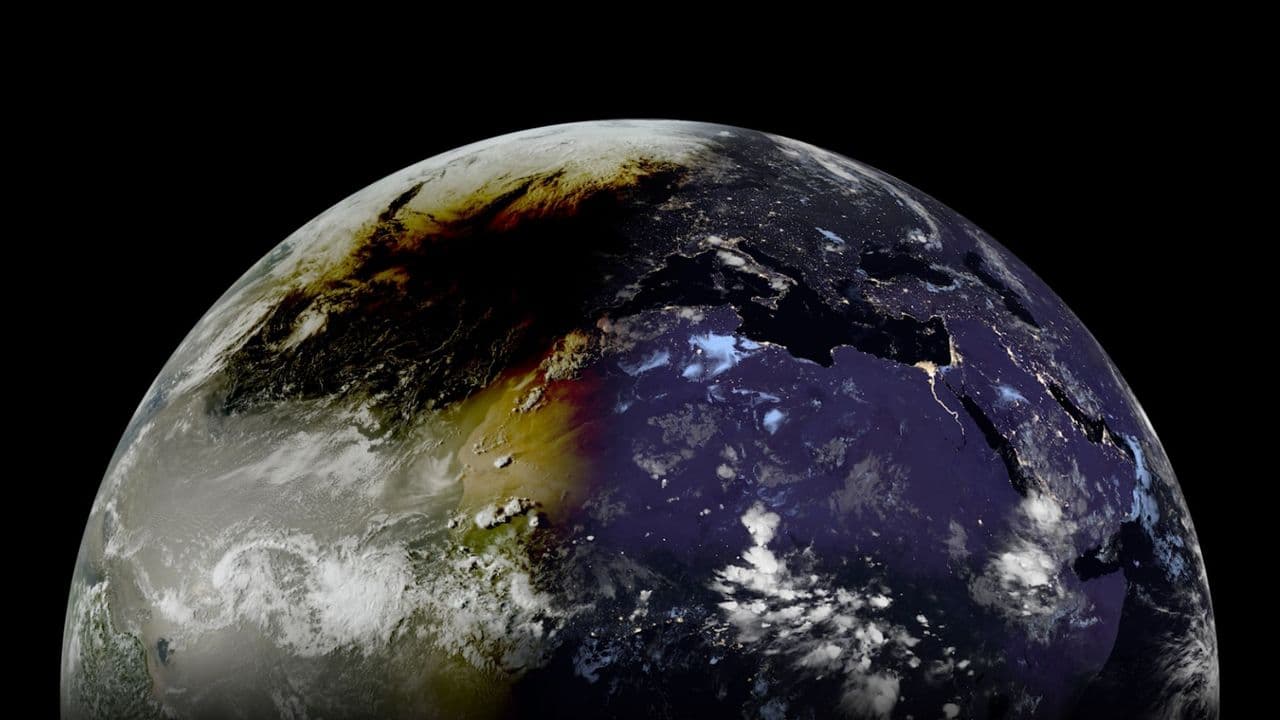
A view of the moon's shadow darkening Earth's surface during the Aug. 12 total solar eclipse, as seen by ESA's MTG-I1 satellite. ( 12 total solar eclipse didn't only plunge millions of people across Greenland, Iceland and Spain into a false twilight — a fleet of spacecraft orbiting our planet managed to capture the magic, too.August's total solar eclipse occurred as the moon passed directly between the sun and Earth during its monthly new moon phase. Those lucky enough to be in the path of totality watched on in awe as the moon progressively swallowed the light of the sun, ultimately revealing our star's tenuous atmosphere against a prematurely darkened evening sky.It was a show of truly epic proportions — and maybe one whose scale can be particularly appreciated when viewed through the mechanical eyes of NASA and European Space Agency (ESA) spacecraft that observe our planet and sun from afar. Read on to see some breathtaking views of the Aug. 12 total solar eclipse from orbit.The Aug. 12 total solar eclipse, seen from spaceOur first view comes courtesy of NASA astronaut Jessica Meir, who captured the moon taking a bite out of the sun from the Russian segment of the International Space Station (ISS) on Aug. 12. The partially eclipsed sun as photographed by NASA astronaut Jessica Meir from the Russian segment of the International Space Station on Aug. 12. (Given the location of the @Space_Station at the time of the total solar eclipse today, we saw only a partial eclipse, with a peak of around 18% sun coverage. Here’s how it looked from a window in the Russian segment about 45 minutes ago. Photo of the sun taken with a Nikon Z9,… pic.twitter.com/BUrMQVR808August 12, 2026Around the same time, photographer Joel Kowsky managed to line up a beautiful shot of the ISS as it passed across the face of our eclipsed star in the skies over Hodgdon, Maine.This gif shows the ISS' silhouette moving across the sun's face during a partial solar eclipse on Aug. 12, 2026. (Both Proba-3 spacecraft are designed to fly in perfect formation in line with the sun. The "Occulter" spacecraft, closest to the sun, is equipped with a large sunshield, or coronagraph. This coronagraph blocks the sun's disk for the more distant member in the Proba-3 formation, allowing that spacecraft to image our star's atmosphere in incredible detail. The sun's disk is pictured hidden behind the coronograph of the lead Proba-3 spacecraft with the moon's silhouette above, just hours before the Aug. 12 total solar eclipse. (0 IGO, alterations made in Canva by Anthony Wood.)Thanks to their unique setup, for a brief moment on Aug. 12, the Proba-3 spacecraft recorded a rare double eclipse, as the moon and its artificial mimic simultaneously hid light emanating from our parent star.Sitting about 22,370 miles (36,000 kilometers) above Earth's surface, ESA's Meteosat Third Generation Imager Satellite (MGT-I1) caught a spectacular view of the moon's shadow darkening our planet.Solar eclipse as seen from space! From its vantage point in space, the Meteosat Third Generation Imager satellite (MTG-I1) captured the Moon’s dark shadow as it passed over Earth’s surface – converging with the advancing twilight shadow as dusk fell over Europe.… pic.twitter.com/dAQVyuXiIPAugust 13, 2026The moon's shadow can be seen arcing south in the satellite imagery, before eventually co
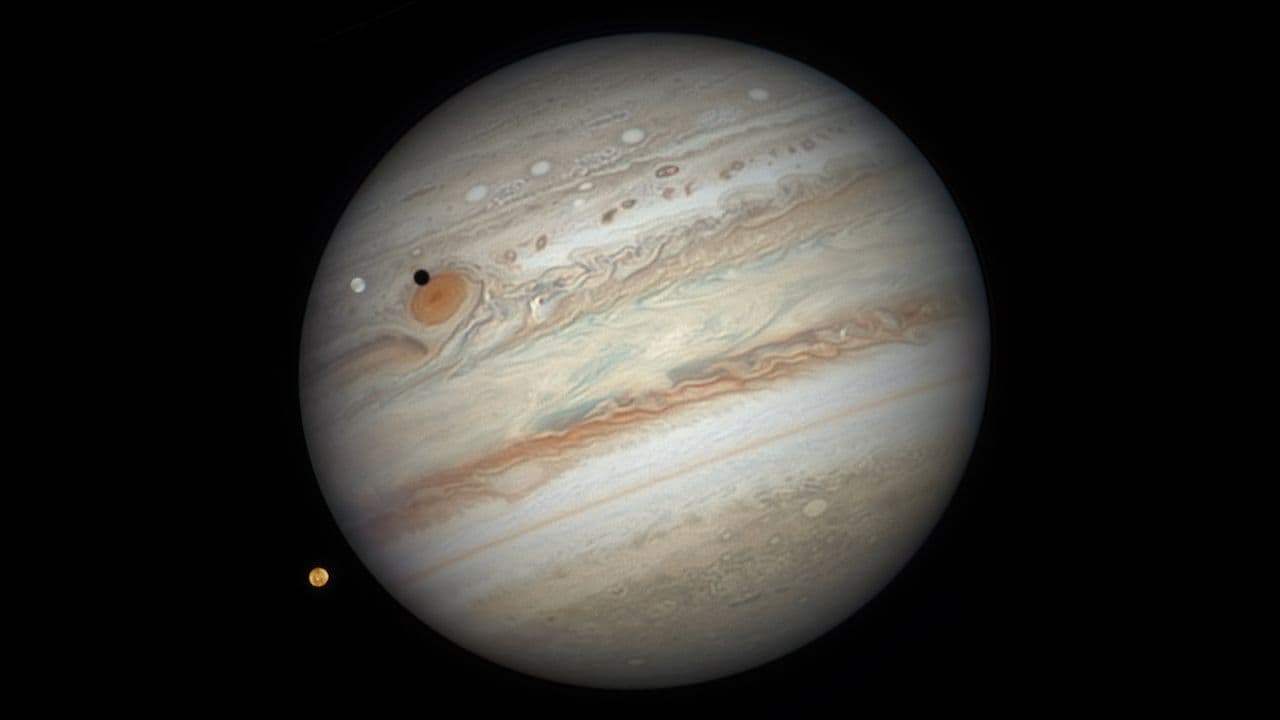
Jupiter with its moons Io and Europa. Captured by the author using a large amateur telescope, it illustrates what is possible today using commercially available equipment and a dedicated approach! ( With even a modest telescope and camera setup, you can capture cloud bands on Jupiter, the majestic rings of Saturn or the polar caps of Mars — images once the preserve of professional observatories. This technique, known as lucky imaging, records short video clips at high frame rates to freeze fleeting moments of steady air, then stacks the sharpest frames into one crisp photo.No advanced skills are required to start. Whether you own a modest backyard telescope or are shopping for your first planetary camera, this guide provides everything needed to succeed. You will learn a complete workflow that takes you from set-up to finished image, explore why certain planets are easier than others and find answers to practical questions that beginners often ask.Clear skies, patience and practice are your only limits. Soon you will be creating gallery-worthy shots right from home.Step-by-step tutorial: Imaging planets with a telescope and cameraPlanetary imaging relies on video capture rather than single long exposures. Follow these 12 steps for reliable results with most setups. Planning observations in advance is essential!
gov)
Discussion (0)