
Loading dispatches...
← Return to NewsroomScience
Scientists find 3 supermassive black holes on the verge of collision inside a distant galaxy
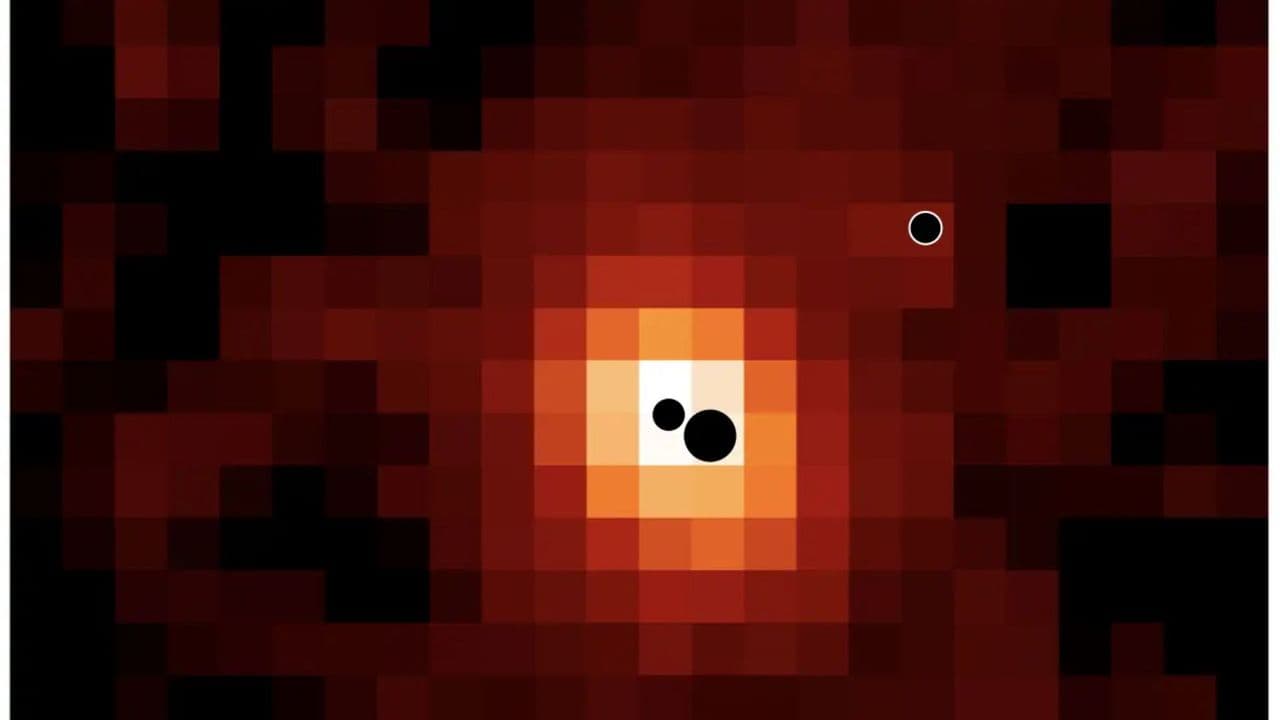
The distant galaxy J0148-4214, seen in the light of ionized hydrogen. The image appears pixelated because of the great distance to the galaxy. The black circles denote the relative locations of the three black holes. (Scientists have discovered the black holes in a galaxy that is so far away its light has taken 12.5 billion years to reach us, meaning we see it as it was less than 1.3 billion years after the Big Bang. And it's offering strong supporting evidence that one of the ways black holes grew so massive so quickly in the early universe was through mergers."This is the first evidence of three active black holes in a single galaxy in the distant universe," Hannah Übler, an astronomer at the Max Planck Institute for Extraterrestrial Physics in Germany who led the study, said in a statement. "It suggests that processes in the early universe were efficient at bringing massive black holes together, setting the stage for the massive black-hole mergers we expect to detect with future gravitational-wave observatories."The galaxy that plays host to the black holes is catalogued as J0148-4214 and is so far away (their redshift is 5.0167) that the James Webb Space Telescope (JWST), which made the discovery, could not see the black holes directly. Instead, the Integrated Field Spectroscopy unit on the JWST's Near Infrared Spectrometer (NIRSpec) measured the motion of hydrogen gas swirling around at high velocity in the accretion disks encircling each black hole."The JWST data allowed us not only to identify the three black holes, but also to estimate their masses, accretion rates and the stellar mass of the galaxy," Giovanni Mazzolari of the Max Planck Institute for Extraterrestrial Physics said in the statement. "We find a total stellar mass of about 1.3 billion suns, and the black holes represent a significant fraction of that."Two of the black holes reside at the center of J0148-4214, separated by 620 light-years. One of these black holes has a huge mass of 80 million times the mass of our sun, while its companion is a relative pipsqueak at 600,000 solar masses. Yet despite its diminutive stature, the smaller black hole is growing at a tremendous rate by accreting gas faster than the Eddington limit. This is the theoretical maximum rate at which material can fall towards a black hole; if the rate is any higher then the accretion disk around the black hole becomes so dense and hot that radiation from the disk blows material back out again, stifling the black hole's feeding frenzy. This means the smaller black hole will only be able to keep growing at this rate for a short time before negative feedback calls a halt.The third black hole is 5,500 light-years out from the center of J0148-4214 and has a mass two million times greater than the mass of our sun. This is about half the mass of the supermassive black hole at the center of our Milky Way galaxy, called Sagittarius A*. It's thought that this third black hole, and quite possibly the second one too, found their way into J0148-4214 via mergers between galaxies."These results are extremely exciting," said Roberto Maiolini of the University of Cambridge, who was a participant in the findings. "They suggest that black-hole merging may be an additional, fast route for their rapid growth in the early universe." An image of Sagittarius A*, the supermassive black hole at the heart of the Milky Way. ( Current gravitational-wave detectors — including The Laser Interferometer Gravitational-Wave Observatory (LIGO) in the United States, Virgo in Italy and KAGRA in Japan — are able to detect the high frequency, short wavelength gravitational waves from the mergers of stellar-mass black holes, the kind formed in cert
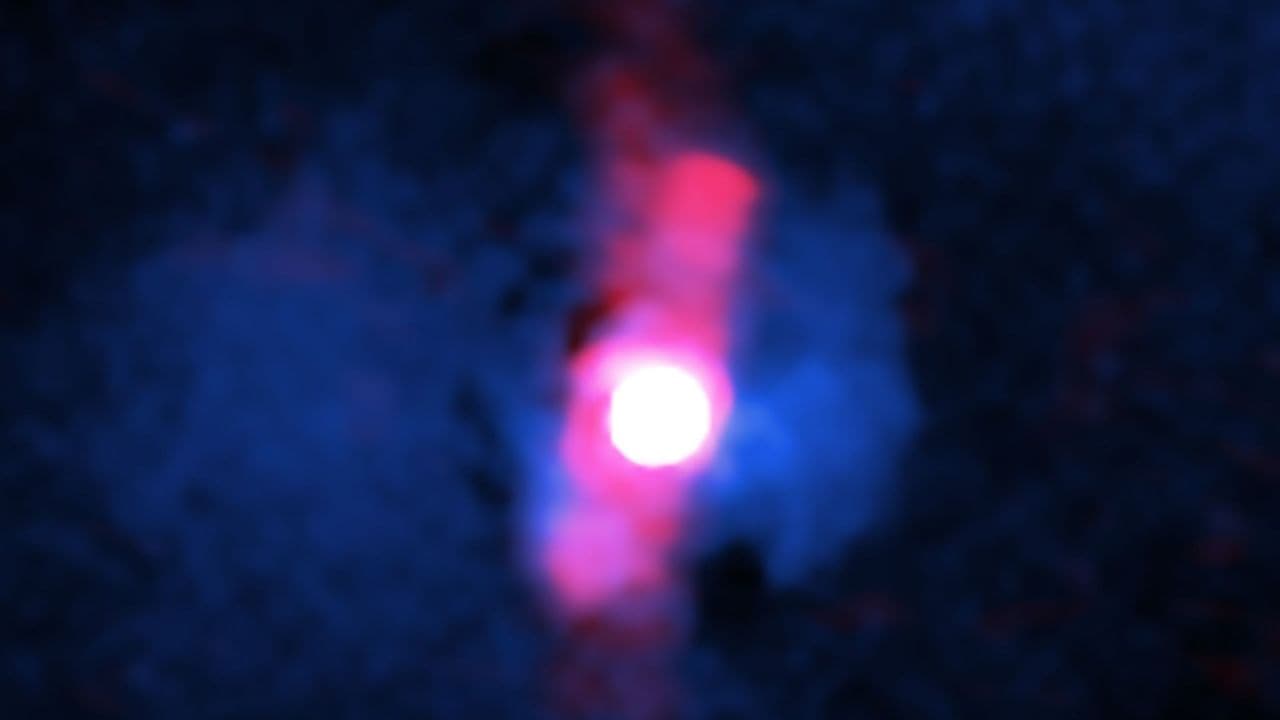
Supermassive black holes are best known for their immense gravity, pulling in everything that strays too close, even light. But new research suggests these cosmic giants can also hurl enormous amounts of energy outward, driving powerful disturbances that ripple hundreds of thousands of light-years through space.A study led by Satoshi Yamada of Tohoku University in Japan found that winds generated by an actively feeding supermassive black hole are about 100 times more powerful than astronomers previously estimated.These outflows, scientists say, inject an amount of energy comparable to several billion supernova explosions, driving turbulence through hot gas across distances of roughly 300,000 light-years —far beyond the boundaries of the host galaxy itself."Black holes are largely known for sucking matter in, but they also eject gas in the form of powerful winds," Yamada said in a statement. "These winds were thought to be contained within the galaxy, but our study revealed that the force is immensely more powerful than previously understood."To measure the extent of those outflows, Yamada and his colleagues observed H1821+643, a bright quasar in the constellation Draco about 3.4 billion light-years from Earth. The galaxy hosting H1821+643 sits at the center of a dense galaxy cluster and harbors an active supermassive black hole estimated to be three to four billion times the mass of the sun.During a weeklong observation in September 2024, Yamada and his team used XRISM, the X-ray satellite launched by Japan's space agency in 2023, to track the chemical signature of ionized iron atoms in the surrounding hot gas. By examining how the light from these iron ions stretched and broadened, the researchers were able to determine how fast the gas was moving and how turbulent it had become, according to the statement.The observations revealed that the turbulence is driven by energy released from the quasar, with its effects reaching distances of about 300,000 light-years from the black hole, the study notes.The result builds on years of observations of H1821+643, which is, in fact, the closest known quasar to Earth located within a galaxy cluster, according to NASA.One of the more intriguing discoveries came in 2022, when observations of the black hole's spin using NASA's Chandra X-ray Observatory showed it rotates half as quickly as its smaller peers, which spin close to the speed of light."The million-dollar question is, why?" Christopher Reynolds, an astronomer at the University of Cambridge and co-author of the 2022 study, said in a statement at the time.According to that study, one leading hypothesis is that giants like H1821+643 grew primarily through repeated mergers with other black holes arriving from different directions. Those chaotic collisions may have repeatedly disrupted the black hole's rotation instead of steadily spinning it up through a long-lived accretion disk.While the exact origin of its sluggish spin remains an open question, the black hole's influence clearly extends far beyond its host galaxy."For the first time, we have shown that black holes influence the broader cosmic environment through a shock wave of astonishing power," Yamada said in the statement."Black holes are key drivers of gas flows and motion in space, transporting vast amounts of energy to different regions of the cosmos."This research is also described in a paper published July 28 in the journal Nature Astronomy.
Discussion (0)