
Loading dispatches...
← Return to NewsroomPolitics
Avoid blame game on Assam floods, says Nagaland coal miners’ body
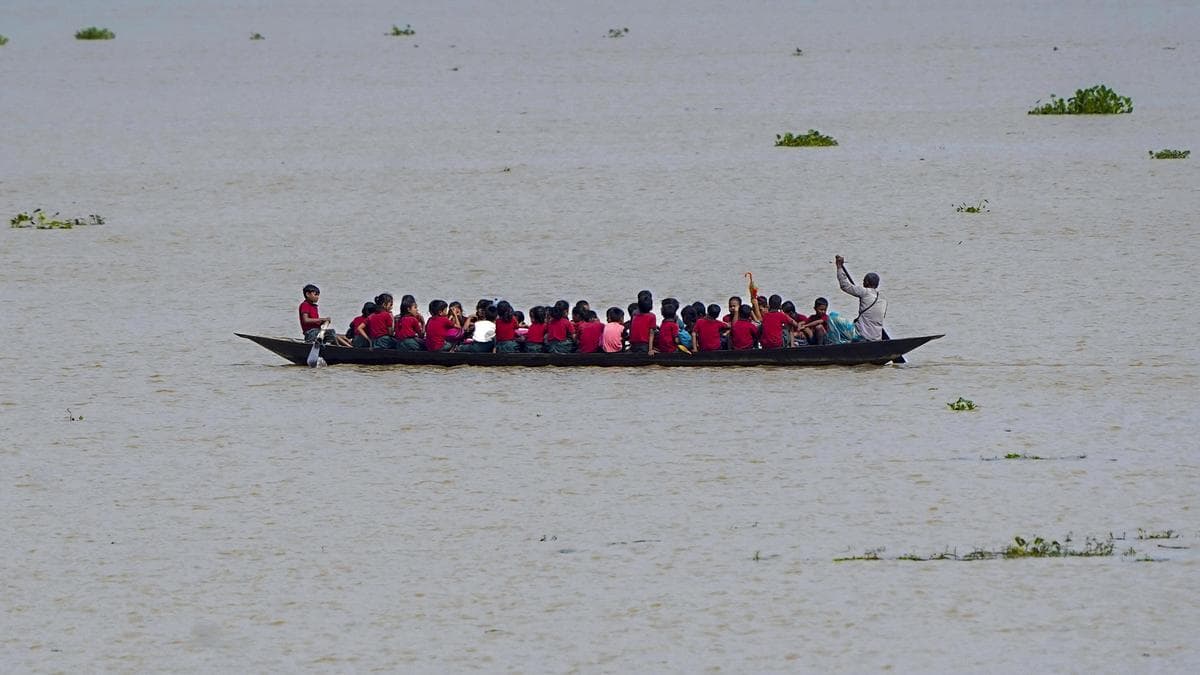
Students travel to school in a country boat after floodwaters submerge roads, in Morigaon district, Assam, Wednesday, Aug. 5, 2026. | The Tuli Area Coal Mining Contractors’ Association (TACMCA) urged people to refrain from making unverified claims and start examining several factors that could have contributed to the extensive damage to lives, homes, livelihoods, property, and public infrastructure.4 lakh affectedTuli, in Nagaland’s Mokokchung district, is a town on the border with Assam. The coal belt on the border between the two States runs from Nagaland’s Wokha through Mokochung to Longleng, Mon, and further beyond in Arunachal Pradesh.Disaster management officials in the two States said floods in Assam and landslips in Nagaland killed at least 115 people between April and August 14, 2026.Many in Assam, including Sivasagar MLA Akhil Gogoi, blamed the unprecedented floods in Sivasagar and Charaideo districts on unregulated and unscientific sand, stone, and coal mining along the inter-State border. He said excess water, accumulated in Nagaland’s coal pits, caused much of the damage in Assam.Rejecting such theories, the TACMCA said that exceptionally heavy rainfall recorded in Nagaland on July 18 led to unusually high water flow and triggered flash floods, particularly in Longleng, Mokokchung, Mon, and Wokha districts.The association said several interconnected factors can lead to extreme weather events, and the recent disaster should not be attributed to one activity or community. It claimed that Nagaland also suffered extensive damage from floods and landslips, although the focus was on Assam.“Natural calamities do not recognise State boundaries or communities,” the association said, appealing to people in Assam and Nagaland not to point fingers at each other.The TACMCA said accusations against an entire State, community, organisation, or group without established evidence could create divisions and cause further distress to people already affected by the disaster. It referred to the shared rivers, hills, forests, roads, markets, and social ties between Assam and Nagaland.“We should help each other, understand each other, and stand together during adversities,” the association said. Published - August 15, 2026 11:46 am IST
GUWAHATI Human factors, and not necessarily climate change, worsened the floods in a part of eastern Assam that killed at least 103 people, a global collaborative study has said.According to the World Weather Attribution (WWA), an international scientific collaboration, heavy monsoonal rainfall in northeastern India has remained within historical norms, but land-use changes have increased the impacts and risks to the people and their livelihoods.Between late June and early August, eastern Assam—particularly Sivasagar, Charaideo, and Jorhat districts—alongside hill catchments in Nagaland and Arunachal Pradesh, experienced intense monsoonal downpours.The resulting deluge breached critical infrastructure, washed away agricultural land, and forced hundreds of thousands into relief camps. Thousands of livestock and other domesticated animals were also affected.Scientists from India, Sweden, the Netherlands, the United Kingdom, and the United States analysed historical weather records and climate models, finding that the rainfall totals were not exceptional and are expected at least every two years.“Although limited datasets for the region mean there is some uncertainty, the analysis showed no clear evidence that climate change was altering the trend in the intensity or likelihood of the rainfall. Instead, they found that the scale of the disaster stems largely from other human factors including colonial-era land regulations, displacement, land degradation, and a lack of sufficient flood mitigation,” the WWA study said on Friday (August 14, 2026).The study found that unplanned urbanisation, rapid deforestation, wetland destruction, and riverbank erosion degraded Assam’s natural drainage capacity, increasing flood height and downstream impacts.The scientists said reliance on concrete engineering and hard embankments trapped silt, artificially raising riverbeds and blocking natural runoff. “Embankments frequently exacerbate flooding and increase the risk of catastrophic breaches,” they noted, observing that combining infrastructure with social and nature-based approaches could be more effective in mitigating floods.Future warmingThe study also flagged historical vulnerability. “Historical land reallocation contributed to some indigenous communities living on marginal, flood-prone riverbanks, and sandbars (chars). These historical patterns continue to trap low-income agricultural populations in cycles of repeated displacement,” it said.“Adaptation efforts must broaden to include floodplain restoration, wetland conservation, and expanded anticipatory disaster risk management using localised early warnings,” the study suggested.“To understand whether climate change played a role in the rainfall in the Upper (eastern) Assam region and the surrounding hill catchments that led to the landslides and flooding, we analysed short, high-intensity downpours, and longer rainfall accumulations,” Mariam Zachariah, a research associate in extreme weather and climate change at the Centre for Environmental Policy, Imperial College London, said.“Low station coverage and climate models struggling to capture processes in hilly regions create high uncertainties in the results. Therefore, overall findings suggest no discernible role of climate change. However, a lack of a clear trend today does not make the region immune to future warming. As global temperatures continue to climb, monsoon dynamics across South Asia will keep shifting, making proactive land and river management even more urgent,” she said.“Hundreds of thousands of people have been affected, with low-income agricultural families and displaced communities paying the highest price. Marginalised populations living on flood-prone sandbars and reliance on rigid concrete embankments can be a recipe for disaster,” Emmanuel Raju, director of Copenhagen Centre for Disaster Research, said.“True adaptation requires moving towards living with rivers through wetland restoration and proactive early action


Discussion (0)