
Loading dispatches...
← Return to NewsroomScience
How 'For All Mankind' evolved from 'The Right Stuff' into 'The Expanse'
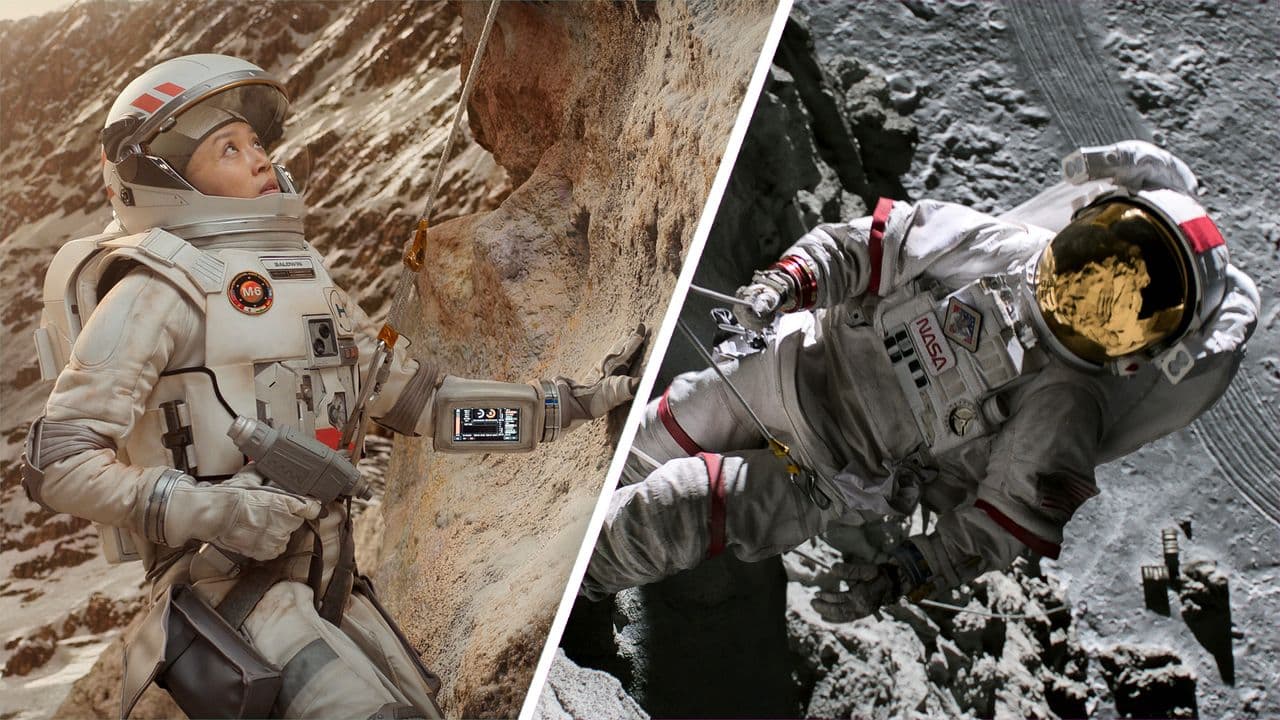
( The death of Ed Baldwin in "Home", the third episode of "For All Mankind"'s fifth season, was a symbolic moment for the Apple TV show. Yes, Margo Madison, Danielle Poole, and (albeit played by a different actor) Aleida Rosales still survive from the show's first season, but Baldwin was the last of the original Apollo astronauts standing.Article continues below ( In this parallel 2012, the (fictional) Apollo astronaut's final resting place is the surface of Mars, where hundreds of people (families included) have now made the thriving Happy Valley base their permanent home.And after four decades on the front lines of space exploration, it's rather poignant that Baldwin should pass away on another planet. He was the bridge between two very different eras, a character who started out in the show's original "Right Stuff"-influenced incarnation and departed a series that's feeling more and more like a prequel to "The Expanse".Alexei Leonov planting the Soviet flag on the Moon in "For All Mankind"'s opening episode is the point where the show's timeline visibly diverges from reality. That said, series creators Ronald D Moore, Ben Nedivi and Matt Wolpert have said the real-world death of Sergei Korolev in 1966 is their actual sliding doors moment. Indeed, the writers surmised that the rocket engineer was so clearly the USSR's MVP that — had Korolev survived the botched medical procedure that killed him — the Soviet space program would have continued to outpace its American counterpart. ( Before Neil Armstrong and Buzz Aldrin set foot on the lunar surface in 1969, the USSR had been first to every significant space travel milestone, from the first satellite, through the first man and woman in space, to the first-ever spacewalk. To use a sporting analogy, America's victory in the race to the Moon was against the run of play, the result of an incredible collective effort and a colossal budget."For All Mankind" speculates, however, that missing out on the Moon would have been the best thing ever to happen to NASA. Instead of simply accepting defeat, the United States upscales its ambitions to establish a permanent presence on the lunar surface. The discovery of water in the Shackleton Crater near the lunar south pole subsequently prompts the US to build the Jamestown base, turbo-charging the space race in the process. (Ed Baldwin is, of course, one of the first astronauts in residence.)This has all happened by 1974, with the hardware still looking distinctly Apollo. But then, after the end credits of the season finale, the show delivers a major rug pull, as a time jump to 1983 reveals a rocket transporting a plutonium payload to power the expanded Jamestown base. ( And by the time season 3 leaps ahead to 1995, we're talking orbital space tourism and a three-way race to Mars between the US, the still-intact Soviet Union and — perhaps inevitably — private enterprise.But it's when the show's fourth season lands in 2003 that "For All Mankind"'s transition into "The Expanse" begins in earnest. Thanks to the narratively expedient invention of plasma drives — why spend two years travelling to Mars when you can do it in two months? — journeys to the Red Planet are almost as straightforward as flying to the other side of the world. And with ordinary people now earning a living at the Happy Valley base, humanity's colonization of the Solar System is in full swing.Some residents (including, of course, the ever-pr

Discussion (0)