
Loading dispatches...
← Return to NewsroomScience
Watch Atlas V rocket launch 29 Amazon Leo broadband satellites early on July 2
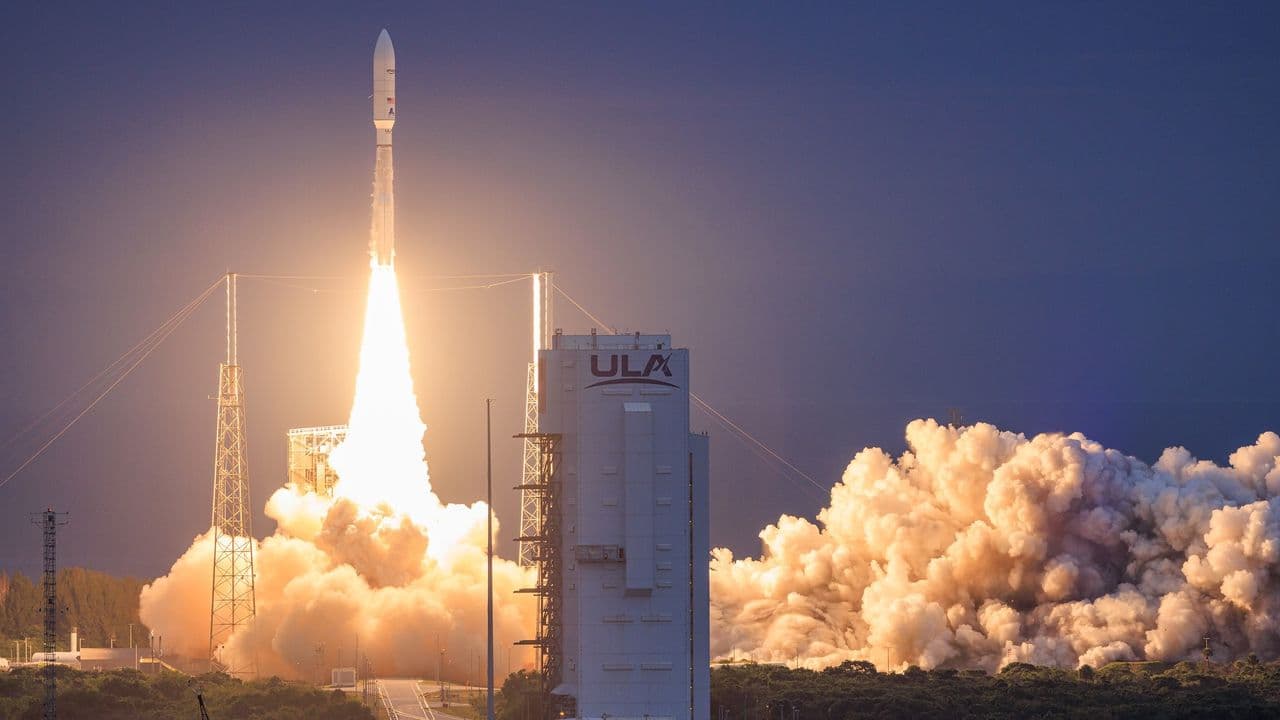
United Launch Alliance (ULA) will launch another batch of Amazon's internet satellites to orbit early Thursday morning (July 2), and you can watch it live.An Atlas V rocket carrying 29 Amazon Leo spacecraft is scheduled to lift off from Florida's Cape Canaveral Space Force Station on Thursday, during a 29-minute window that opens at 12:24 a.m. EDT (0424 GMT).You can watch it live here at Space.com courtesy of ULA, or directly via the company. Coverage will begin at around midnight EDT (0400 GMT). A United Launch Alliance Atlas V rocket lifts off from Florida’s Cape Canaveral Space Force Station on May 29, 2026 carrying 29 satellites for the Amazon Leo broadband constellation. ( It will compete with SpaceX's Starlink network, which has nearly 11,000 satellites at present and is growing all the time.About 370 Amazon Leo craft have reached orbit on a total of 14 missions to date, atop three different rockets — the Atlas V, SpaceX's Falcon 9 and Arianespace's Ariane 6.The Atlas V has been the most active of this trio, conducting 8 of the liftoffs for the megaconstellation, which was originally known as Project Kuiper. (The first of those Atlas V launches lofted two prototype satellites, not operational craft, which explains why Thursday's mission is called Amazon Leo 8 rather than Amazon Leo 9.)The Atlas V flying on Amazon Leo 8 is the 551, the most powerful variant of the rocket. The numbers mean that it sports five solid rocket boosters, a 5-meter-wide (16.5 feet) payload fairing and a Centaur upper stage with a single engine.The 29 Amazon Leo satellites going up on Thursday weigh a total of about 18 tons, tying the record for the heaviest load ever launched by an Atlas V. That mark was set on the Amazon Leo 5 mission in early April and has been equaled multiple times since.
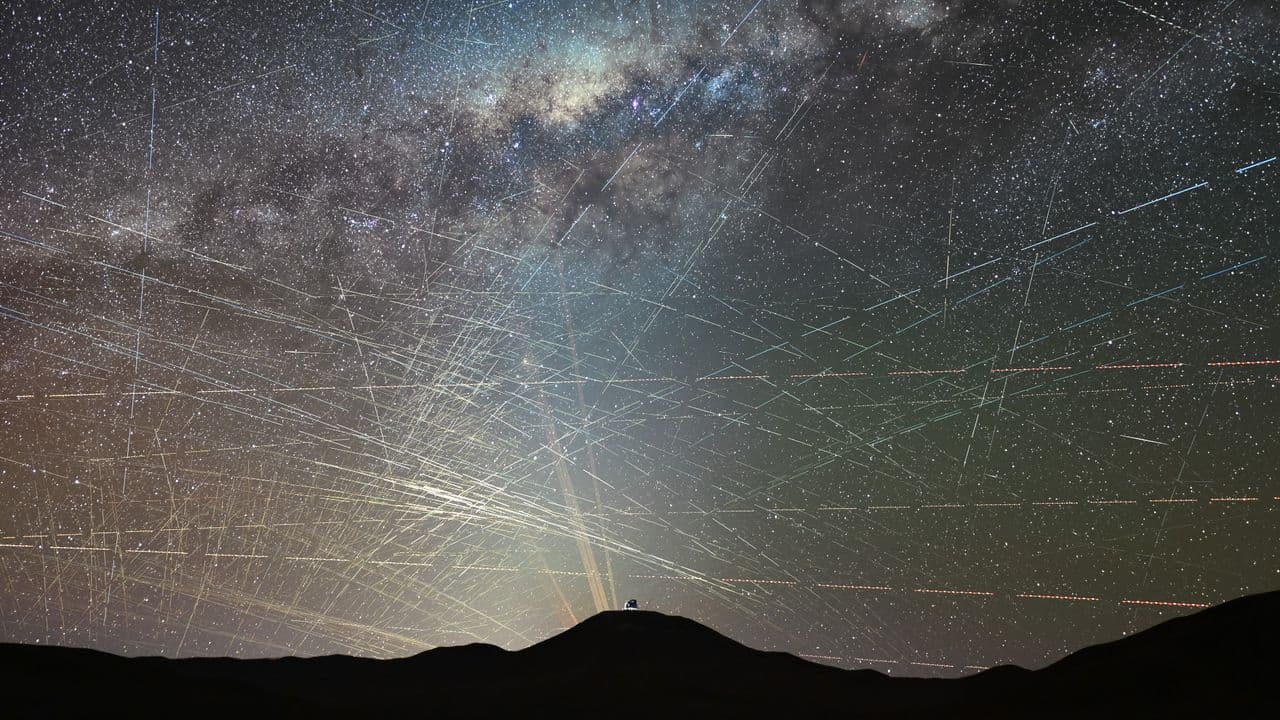
One hour of satellites over the northern Atacama Desert in Chile in October 2025. ( Kamphues, ESO/M. Kornmesser) If the number of satellites in Earth's orbit exceeds 100,000, humanity may lose its ability to study the universe from the planet's surface.That's the conclusion of a study conducted by astronomers from the European Southern Observatory (ESO) which warns that if existing plans to deploy a million orbiting data centers and tens of thousands sun-reflecting mirrors were to come to fruition, the world's most cutting-edge astronomical telescopes may as well be mothballed."We can reach conditions where basically, there is no point in operating the telescopes anymore because all the data will be corrupted. All. 100 percent," Olivier Hainaut, the director of operations at ESO and lead author of the study, told Space.com.Hainaut used computer modelling to understand the effect of varying numbers of satellites of different brightness levels on astronomical observations. The modelling showed that if 100,000 satellites were to orbit the planet and all were barely visible to the naked eye, astronomy could cope. If those satellites were brighter, however, around magnitude 7 or below in astronomical terms, astronomical research would become more difficult and costly.Satellites affect the sky in two ways. Firstly, the sunlight they reflect increases the overall brightness of the sky, creating light pollution. Second, brighter satellites also create streaks in telescope images that mar observations."If you increase the light pollution, it means that you will see fewer natural stars and you will see more of these satellites," said Hainaut . "For telescopes that means increasing exposure times. If you have a 10 percent increase in light pollution, you have to increase all the exposure times by 10 percent. It scales directly. For a 100 percent increase in light pollution, you have to increase all the exposures by 100 percent."The exposure time increases mean that less science gets done and every observation becomes more expensive. The International Astronomical Union says that an increase in light pollution by more than 10 percent compared to natural dark sky conditions is an astronomy killer.As light pollution has spread with urban development over the past two centuries, astronomers have increasingly been retreating into ever more remote locations. Many of the world's most expensive telescopes, including the Vera C. Rubin Observatory and the ESO's Very Large Telescope and Extremely Large Telescope, are located in Chile's Atacama Desert where the night sky is still nearly perfectly dark.But while it is possible to retreat from the city lights, there will be no escape from satellite light pollution, Hainaut warns. You may be visiting a tiny village in Africa, camping in the Australian outback, or on an expedition to Antarctica or the Amazon rain forest, and your sky would still be brightened by the satellites. This diagram shows the number of satellites that would be visible above ESO's Very Large Telescope (VLT) if SpaceX launches their planned constellation of 1 million satellites. ( Hainaut)"What they propose would make our observations close to impossible"What is worse, if plans to launch thousands of sun-reflecting mirrors, as proposed by the U.S. company Reflect Orbital, were to come to fruition, the sky would transform completely.Headquartered in Hawthorne, California, Reflect Orbital's vision is to deliver light on demand to solar power plants at night and to illuminate warzones and areas struck by natural disasters. The company has applied to the Federal Communications Commission (FCC) to launch a demonstration space mirror into orbit later this year.The satellite, called Eärendil-1, is 59 by 59 feet (18 by 18 meters) in size, and should be the first in a constellation of 50,000, if things were to go according to Reflect Orbital's plan. "Reflect Orbital is really bad," said Hainaut."What t
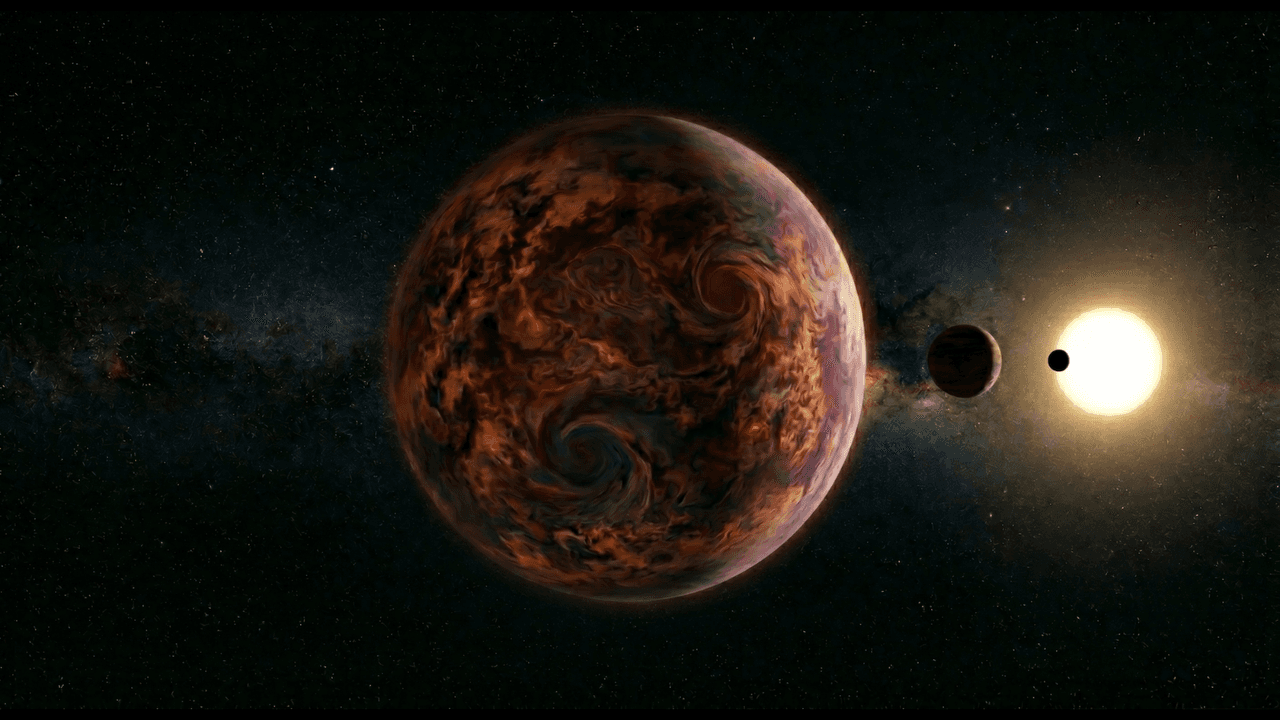
Using NASA's exoplanet-hunting spacecraft TESS (Transiting Exoplanet Survey Satellite), scientists have discovered a planetary system that scientists are calling "improbable." It could change how we think about the mechanisms behind planet formation.The reason for the unusual arrangement of this planetary system is a failed star or brown dwarf designated TOI-201 c. Objects like this get the slightly unfair nickname of "failed stars" because, despite forming from a collapsing cloud of gas and dust like other stars, they fail to gather enough mass to trigger nuclear fusion of hydrogen to helium in their cores. Brown dwarfs have masses between 13 and 80 times that of Jupiter, or 0.013 to 0.08 the mass of the sun. That puts them right between the most massive planets and the smallest stars.TOI-201 c is on a highly elliptical orbit, taking 2,881 days to orbit its star, which has resulted in planets including a super-Earth named TOI-201 d and a warm Jupiter named TOI-201 b, forming in a narrow zone within its orbit, something that isn't just new to astronomers; it is completely unexpected based on planetary formation models.The 5.8-day orbit of TOI-201 d and the 53-day orbit of TOI-201 b are both perfectly aligned with the orbit of the brown dwarf. The brown dwarf creates gravitational instability at distances equivalent to the distance between Mars and the sun, but this didn't prevent planets from forming in the system."This discovery provides a crucial insight into how planets form even around massive, eccentric objects," team member and INAF researcher Aldo Bonomo said in an emailed statement.The system challenges the idea that gas giant planets form at distances equivalent to 2 to 3 times the distance between Earth and the sun in the disks of gas and dust that surround stars during their infancy."The presence of the brown dwarf on such an elliptical orbit forced the planets to form and survive by occupying the innermost and hottest edges of the primordial disk," team member Luca Naponiello of the National Institute for Astrophysics (INAF) said in the statement. "Furthermore, the data show that during the close approach of the brown dwarf, the warm Jupiter undergoes strong and sudden variations in its transit timing, bearing witness to an intense and vigorous dynamic interaction currently underway between the two giants."The system was discovered by TESS using a rare mono-transit event, which describes a planetary body making one crossing of the face of its star, causing a dip in starlight. This was followed by an observing campaign conducted from the ground.It is extremely rare to discover objects like TOI-201 c with such long and eccentric orbital periods using transits they make of their parent star. This brown dwarf is the first one of these objects to have its mass confirmed, making it an important step forward in astronomy."It [TOI-201c] is the transiting object with the longest orbital period for which the mass is known," Naponiello said.The team's results were published on Wednesday (June 17) in the journal Nature.

Look for the Great Diamond of Spring in May's night sky and discover the rich realm of galaxies within. (Looking high overhead and toward the south just after nightfall, there is a broad star pattern formed by four stars. The near-third magnitude star, Cor Caroli (in the constellation of Canes Venatici the Hunting Dogs), is the faintest of the four that comprise a large diamond frame that can be found high in the sky and due south at around 10 p.m. local daylight time. The other stars in the diamond are second magnitude Denebola (marking the tail of Leo, the Lion), first magnitude Spica (the spike of wheat in the hand of Virgo) and zero-magnitude Arcturus (in Boötes the Herdsman).In his popular constellation guide, "The Stars — A new Way to See Them," author Hans A. Rey (1898-1977) called it the "Virgin's Diamond," after the constellation of Virgo, though others refer to it simply as "The Great Diamond."But it's not sanctioned. . . Of course, the Diamond is not an official constellation but is an asterism. The constellations shown on modern star atlases are all officially approved by the International Astronomical Union (I.A.U.), but while constellations are official, asterisms are not. An asterism is often defined as a noteworthy or striking pattern of stars within a constellation, but that is not always the case. The Big Dipper is not a constellation itself, but an asterism which is part of the larger constellation of Ursa Major, the Great Bear. The Great Diamond in the night sky. ( The two main reasons are that different people see constellations in different ways and that, as far as astronomy today is concerned, constellations are not considered star pictures but as specific sky areas. The official constellation boundaries were drawn up in 1930. Before that time, no two atlases agreed as to the limits, and much confusion resulted.So, while the Diamond is not "official," it still is recognized as a landmark star pattern of the spring season.And even here, some see this pattern differently. If, for example, we don't include Cor Caroli, then the Diamond becomes "The Spring Triangle."Stellar statsHere are some noteworthy details about each star, going from brightest to faintest:Arcturus: A brilliant star that sparkles with a golden yellow or topaz hue, it is the brightest star in the constellation Boötes the Bear Driver. In late spring and early summer, Arcturus is usually the first star you see after sunset, soaring high in the southern sky. It ranks as the fourth brightest star in the sky and is a giant, fully 26 times the diameter of the sun and 170 times as luminous.Its main claim to fame is that it opened Chicago's Century of Progress Exposition of 1933 by shining on a photoelectric cell and moving through space at 76 miles (122 km) per second, which means that over the centuries, it changes its place in the sky more rapidly than any of the other bright stars.Spica: In Greek and Roman tradition, the constellation of Virgo was identified with the goddess of justice, Astraea, who ruled the world during the fabled Golden Age. In the old allegorical star books, the goddess holds some spikes of wheat in each hand and her brightest star — Spica — glows in one of the ears of grain hanging from her left hand. Spica is the 16th brightest star in the sky and is 250 light-years away. It is not one star but two, positioned so close to one another that they are egg-shaped rather than spherical, and can only be separated by their spectra; the two components orbit each other every four days. The primary star is about 20,000 times more luminous tha
An Angara rocket launches the COSMOS 2560 satellite from Plesetsk Cosmodrome on Oct. 15, 2022. Another trio in the COSMOS series — COSMOS 2581, 2582 and 2583 — launched in February 2025 and has performed sophisticated rendevzous operations in orbit. (The satellites, known as COSMOS 2581 and COSMOS 2583, got within just 10 feet (3 meters) or so of each other on April 28, according to COMSPOC, a Pennsylvania-based space situational awareness company."This wasn't a coincidental pass — COSMOS 2583 performed several fine maneuvers to maintain this tight configuration," COMSPOC wrote in a May 1 X post, which featured an animation of the rendezvous.🛰️Russian satellites multi-object proximity event in LEORadar tracking data via @LeoLabs_Space, processed through COMSPOC SSA Suite.This week we observed a complex proximity event involving Russian satellites: COSMOS 2581, 2582, 2583, and Object F (a subsatellite released by… pic.twitter.com/3nDkcOmTuDMay 1, 2026The two satellites and a third one, COSMOS 2582, launched to low Earth orbit in February 2025 atop a Soyuz rocket. According to COMSPOC, all three of them were involved in the recent rendezvous and proximity operations (RPO), as was "Object F," a subsatellite previously deployed by COSMOS 2583.During the 10-foot close approach, "COSMOS 2582 trailed the formation at sub-100 km range, while Object F passed within 15 km of 2582 and within 10 km of 2581 — neither maneuvered," wrote COMPSOC, which analyzed radar tracking data gathered by the California company LeoLabs."For context: in late 2025 to now, we tracked these same COSMOS satellites performing 3-object RPO," COMSPOC added in the May 1 X post. "Whatever Russia is testing, it's sophisticated."Such sophisticated orbital maneuvering is not exactly surprising; we've seen similar things from Russia before. For example, according to outside observers, the nation has operated multiple "inspector satellites," including COSMOS 2542, which made a close approach to a U.S. spy satellite in 2020.The other major space powers have such capabilities as well. American and Chinese satellites have also been observed checking out other nations' spacecraft high above Earth. Michael Wall is the Spaceflight and Tech Editor for Space.com and joined the team in 2010. He primarily covers human and robotic spaceflight, military space, and exoplanets, but has been known to dabble in the space art beat. His book about the search for alien life, "Out There," was published on Nov. 13, 2018. Before becoming a science writer, Michael worked as a herpetologist and wildlife biologist. He has a Ph.D. in evolutionary biology from the University of Sydney, Australia, a bachelor's degree from the University of Arizona, and a graduate certificate in science writing from the University of California, Santa Cruz. To find out what his latest project is, you can follow Michael on Twitter.
Discussion (0)