
Loading dispatches...
← Return to NewsroomScience
Get stabilized views of the cosmos with the Canon 18x50 IS binoculars, now almost 30% off

The Canon 18x50 IS binoculars are a great pair of astronomy binoculars, thanks to excellent image stabilization. ( The 50mm objective lenses are the benchmark for stargazing binoculars and are able to deliver bright views of the night sky. They are currently 30% off their retail price.You can get the Canon 18x50 IS all-weather binoculars on sale for $1195 from Amazon.When it comes to stargazing, image-stabilized binoculars are a cut above the rest. Even at high magnifications, you get detailed views of night sky objects like star clusters and nebulas, instead of shaky worms of light. Our expert reviewer gave the Canon 18x50 IS binoculars four stars and called them 'stargazing ready' thanks to their high 18x magnification and image-stabilization. Harry joined Space.com in December 2024 as an e-commerce staff writer covering cameras, optics, and skywatching content. Based in the UK, Harry graduated in 2019 with a Bachelor's degree in American Literature with Creative Writing from the University of East Anglia. A keen photographer, Harry has captured celestial objects in his astrophotography and has strong experience with a range of cameras, image-stabilized binoculars and smart telescopes. We've got you covered with reviews and rankings of the best telescopes, binoculars, star projectors, cameras, drones, Lego, streaming and more.Image 1 of 6The Canon 18x50 IS binoculars don't need a tripod for stargazing thanks to the image stabilization.( Especially at higher magnifications, image stabilization becomes a necessity when using the binoculars without a tripod and you can struggle to get a shake-free view without it.The Canon 18x50 IS binoculars offer a powerful 18x magnification and 50mm objective lenses for great astronomy performance. You don't need to worry sacrificing low-light capability for image-stabilization. The star clusters, galaxies and nebulas are bright without becoming lines of squiggly light. They are brilliant for bird watching and general use, too, with the image stabilization adding to the quality of all views.The optical technology stands out with ultra-low dispersion (UD) glass elements for virtually no chromatic aberration (color fringing) and doublet field flatteners for sharp stars from edge-to-edge. Optics expert, Jase Parnell-Brookes, gave them four stars in their full Canon 18x50 binoculars review for enabling a relaxing and impressive session of stargazing. They highlighted the strong grip for sturdiness in challenging conditions but even though they are advertised as all-weather, they are not fully waterproof. At 27% off asking price, this is a huge saving on a pair of binoculars we think are among the best for stargazing.Key features: 18x magnification, 50mm objective lens diameter, 3.7-degree field of view, 15mm eye relief, 41.6 oz (1.2 kg).Price history: The Canon 18x50 IS binoculars have a retail price of $1,648 but are often discounted from Amazon for $1,549. This deal from an Amazon seller brings the price down to $1,195, with the official Amazon listing on sale for $1,199.Price comparison: Amazon: $1,195 | BHPhotoVideo: $1,449 | Adorama: $1,149 Reviews consensus: In our Canon 18x50 IS binoculars review, we praised their the premium features that made it perfect for stargazing: 18x magnification, 50mm objective lenses and superb image stabilization.Space: ★★★★✅ Buy it if: You want high powered views of the universe from handheld binoculars without the need for a tripod.❌ Don't buy it if: If you don't need high magnification or image-stabilization, a lower magnification pair might be more suited to you, like the Nikon Action 7x50 binoculars.Check out our other guides to the best telescopes,

These image stabilizing binoculars are an even better deal at $100 off in this pre-Prime Day deal. ( That’s where these powerful all-weather Canon 18x50 IS binoculars come in. We think they’re the best image stabilized binoculars for magnification and thanks to this pre-Prime Day deal, they’re $100 off.Get these Canon 18x50 IS binoculars for $1549 from B&H PhotoCanon’s gear features in our guides to the best cameras, best lenses and best binoculars, and the Canon 18x50 IS binos are well up to Canon's high standards.In their Canon 18x50 IS binoculars review, our expert Jason Parnell-Brookes awarded them four stars, lavishing praise on their optics, image stabilization, ease of use and more. With their excellent low-light performance, they proved superb for stargazing.Now's a great time to take advantage of this summer deal, too. June 16 sees Mercury shining alongside a sliver of the moon and at $100 off, these Canon 18x50 IS binoculars are perfect for bringing this conjunction into beautiful focus. The good news is this deal is from B&H, so if you want to avoid spending with Amazon on Prime Day, this is a great option.Chris is a freelance journalist who, when not writing or falling further down the Lego rabbit hole, indulges his taste for horror, sci-fi and the post-apocalyptic. As well as Space.com, you can find his work at GameSpew (where he’s the weekend editor).We've got you covered with reviews and rankings of the best telescopes, binoculars, star projectors, cameras, drones, Lego, streaming and more.Image 1 of 4The combination of magnification power and image stabilization makes these an ideal tool for observing the night sky without a tripod.( Earning four stars in our Canon 18x50 IS binoculars review, these image-stabilizing binoculars boast superb image quality. The 50mm object lenses admit plenty of light and the 18x magnification brings the cosmos closer than some telescopes.Their image quality is further enhanced by the inclusion of Canon’s proprietary UD (ultra-low dispersion) lens elements and Super Spectra coating.A little over 1 kg, these porro prism binoculars are heavier than some and, correspondingly, harder to hold for long periods of time. However, the image stabilization eliminates the wobble that would otherwise creep in and ensures rock-solid viewing; our expert Jase found it preferable to attaching them to a tripod.Their only real complaint was that, despite being advertised as all-weather, the Canon 18x50 IS binoculars are not strictly waterproof or fogproof (though they had zero issues with fogging during the test). Now, at $100 off, these are a superb investment for stargazers or nature-watchers.Key features: 18x magnification, 50mm objective lens diameter, 3.7 degrees angular field of view, 15mm eye relief, 41.6 oz (1.18 kg) weightPrice history: These binos dropped to $1155 last Cyber Monday but $100 off is still a respectable saving. They're currently also the same price at Adorama and Best Buy.Price comparison: BHPhotoVideo: $1549 | Adorama: $1549 | Best Buy: $1549 Reviews consensus: We praised virtually every aspect of these binoculars in our Canon 18x50 IS binoculars review, from magnification to image stabilization to ease of use. The reviews from purchasers are just as positive.Space: ★★★★ | Live Science: ★★★★½✅ Buy it if: You’re a stargazer after a pair of powerful image-stabilized binoculars that offer superb image quality coupled with excellent magnification.❌ Don't buy it if: You’re on a tight budget and don’t need IS. Instead, consider these Celestron SkyMaster Pro 20x80 binoculars, which offer excellent image quality for much less moneyCheck out our other guides to the best telescopes

Venus-Jupiter conjunction 2026. Wow! Best photos here EarthSky Venus, Jupiter Converge in Stunning June 9th Dusk Conjunction Sky & Telescope How to see the 'cosmic kiss' of Jupiter and Venus in the night sky National Geographic Jupiter and Venus looked spectacular in this week's planetary conjunction. Here are our favorite photos Space In Photos: See Venus And Jupiter’s Brilliant ‘Kiss’ In The Night Sky Forbes
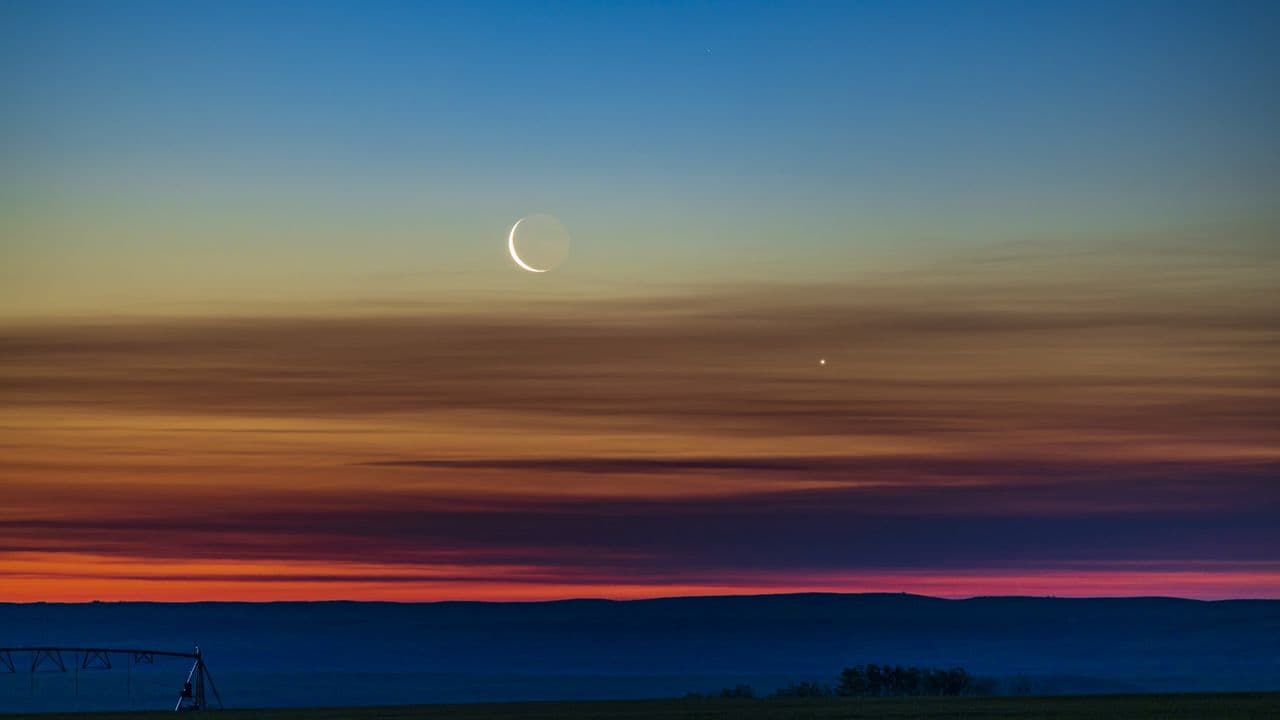
The moon and Venus will shine close together on May 18. This photograph shows the pair shining bright at dawn on June 26, 2022. ( On the evening of May 18, the brilliant planet will be joined by a slender crescent moon just 2.1 days past the new moon and only 7% illuminated.Whenever these two objects pair off, they always attract attention even when they are not particularly close together.Your clenched fist held at arm's length measures roughly 10 degrees and on Monday evening, you will find our natural satellite situated about 3 degrees — or about one-third of a fist — to the right of Venus.Ever wonder which is brighter, Venus or the crescent moon?Many will probably say Venus because it appears as a small, sharp point of light, but it is the moon that is the brighter of the two. Currently, Venus shines at an eye-popping magnitude of -4.0, but the crescent moon, thin as it is, is magnitude -7.1 or 17 times brighter! It might be difficult to accept this, but the reason is that the moon's light is spread out over a much larger area compared to Venus, thus making it appear dimmer. Approximate positions of the moon, Venus and Jupiter around 10:30 p.m. local time on May 18. ( The moon is 224,000 miles (360,000 km) from Earth, while Venus is 124 million miles (200 million km) away. But on Monday, they will be lined up in such a manner to appear relatively close to each other.During May, Venus's elongation from the sun increases from 24 to 32 degrees and from north temperate latitudes, making it easy to spot — hanging in the western sky at dusk and nearing the peak of its not very lofty 2026 apparition. It's some 10 to 20 degrees to the east of the sun and 25 degrees above the horizon. Because a bright sky helps subdue Venus's glare, this is a good time to inspect the planet telescopically, though its gibbous disk remains rather small and approximately seven-eighths illuminated.Venus sets around 10:50 p.m. local daylight time. During the second week of June, when it will be at the pinnacle of its current evening visibility, it will set just after 11 p.m.Joe Rao serves as an instructor and guest lecturer at New York's Hayden Planetarium. He writes about astronomy for Natural History magazine, Sky and Telescope, The Old Farmer's Almanac and other publications. Joe Rao is Space.com's skywatching columnist, as well as a veteran meteorologist and eclipse chaser who also serves as an instructor and guest lecturer at New York's Hayden Planetarium. He writes about astronomy for Natural History magazine, Sky & Telescope and other publications. Joe is an 8-time Emmy-nominated meteorologist who served the Putnam Valley region of New York for over 21 years. You can find him on Twitter and YouTube tracking lunar and solar eclipses, meteor showers and more. To find out Joe's latest project, visit him on Twitter.
(May's new moon phase occurs at 4:01 p.m. EDT (2001 GMT) on May 16, as the moon passes close to the sun in the daytime sky.Visible planetsTurn your gaze west at sunset to spot Venus glowing as a bright "evening star" a little over 20 degrees above the horizon — roughly the width of two clenched fists held at arm's length against the night sky.Jupiter glows another 20 degrees to the upper left of Venus, with Castor and Pollux, the brightest stars in the constellation Gemini, shining above. A pair of 10X50 binoculars will reveal a shoal of star-like objects surrounding the gas giant. These are Jupiter's largest natural satellites Io, Europa, Ganymede and Callisto, which are collectively known as the Galilean Moons in honor of their discoverer, the famed Italian astronomer Galileo Galilei.Early birds are treated to an entirely different cast of planets as Saturn shines above the eastern horizon in the hour preceding dawn, with Mars rising to its lower left, chased by the golden light of the coming sun. Both Saturn and Mars will cling less than 20 degrees above the horizon at sunrise, so be sure to find a spot with a clear view to the east if you want to catch the planetary duo before they're lost in the glare of the sun.Stars and constellationsMay's new moon is a great time to spot a trio of celestial animals shining in the spring sky. Our first target is the great lion represented in the constellation Leo, whose mane and chest are represented by a sickle-like formation of stars that shines above the southwestern horizon after sunset in May, with Regulus at its lowest point.The second-century Greek philosopher Ptolemy catalogued the constellation almost 2,000 years ago, seeing in it the Nemean Lion from the mythological tale of Heracles, which the hero was burdened with slaying as the first of his 12 labors. Starchart showing the locations of the constellations Lynx, Leo and Leo Minor in the spring night sky. ()Next, look 10 degrees above Leo's sickle head to find the faint stars of the constellation Leo Minor, the "little lion". This constellation was created by the Polish astronomer Johannes Hevelius in the year 1690. As a result, there are no great mythological tales of its origin, though it remains a pretty feature between the greater stellar citadels of Leo and Ursa Major.To the lower right of Leo Minor is the magnitude +3.25 star Alpha Lyncis, which forms the leftmost point of the constellation Lynx — a serpentine formation of eight stars that stretches off to the right above the northwestern horizon for viewers in the Northern Hemisphere. Dark skies surrounding the new moon make Lynx much easier to trace, as it is often hidden in the glare of Earth's satellite. An annotated photo of the Milky Way captured by photographer Josh Dury, showing the stars of the Summer Triangle asterism alongside prominent nebulas. ( A good way to spot the Milky Way is by locating the three bright stars Altair, Vega and Deneb, forming a famous asterism known as the Summer Triangle above the eastern horizon this time of yearThe dense starfield and dark interstellar dust clouds of the galactic core appear as a glowing band passing through Deneb and between Vega and Altair, as it tumbles towards the horizon.Read more: Learn the night sky without an app: May's easiest star-hops for beginnersNatural light pollution will be at a minimum, so why not also try to head away from bright city lights to make the most of the monthly pocket
Discussion (0)