
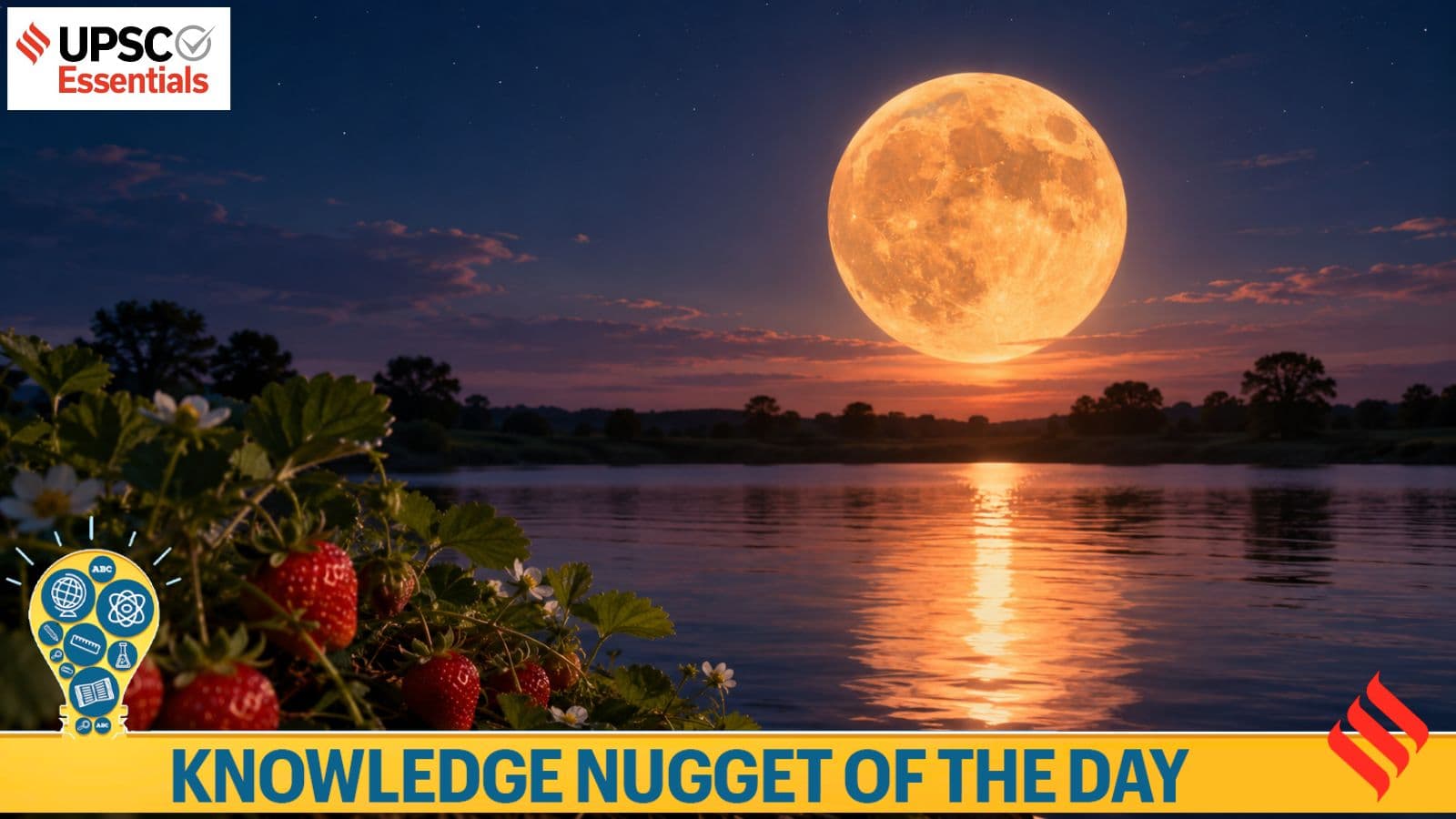
Knowledge Nugget: What makes Strawberry Moon different from Blue Moon and Micromoon?
Take a look at the essential events, concepts, terms, quotes, or phenomena every day and brush up your knowledge. Here’s your UPSC Current Affairs knowledge nugget for today on Strawberry Moon. June’s full moon, popularly known as the Strawberry Moon, is set to light up the night sky. Despite its name, the moon does not appear pink or red. Instead, the name comes from the strawberry harvesting season observed by Native American tribes. In this context, let’s know about it and other astronomical events such as blue moon and Micro moon. 1. The main attraction of June’s Strawberry Moon is how low it appears in the sky when viewed from the Northern Hemisphere. It rises in the southeastern sky and is close to the horizon. Unlike a winter full moon that rises high overhead, the Strawberry Moon follows a low path across the southern sky, lingering close to the horizon throughout the night. 2. The name ‘Strawberry Moon’ comes from Native American Algonquian tribes, who associated June’s full moon with the brief season when wild strawberries ripen and are ready to be harvested, according to the Old Farmer’s Almanac. 3. While the Strawberry Moon does not actually appear larger than usual, it can seem bigger when it is close to the horizon because of the Moon illusion. This is essentially an optical illusion that makes the Moon look larger against buildings, trees, and other objects. 4. At the same time, its light passes through more of Earth’s atmosphere, scattering shorter blue wavelengths and giving the Moon a warm golden or orange glow. 5. This year’s Strawberry Moon is also the first full moon of summer in the Northern Hemisphere, adding to its seasonal significance.Story continues below this ad 6. The June Strawberry Moon will reach peak illumination at 7:57 pm. EDT (11:57 pm GMT) on June 29. At that moment, the Moon will be directly opposite the Sun in Earth’s sky, making its Earth-facing side appear fully illuminated. 7. This year’s June full moon will also follow the lowest path across the sky of any full moon, as it occurs close to the Northern Hemisphere’s summer solstice. As a result, it will appear unusually low above the horizon, creating a striking sight for skywatchers. Blue moon 1. Though the expression “once in a blue moon” implies a rare or unusual occurrence, a blue moon is not that rare an astronomical event. 2. There are a few definitions of a blue moon. One that is most commonly understood — and endorsed by NASA — describes a situation when a full moon is seen twice in a single month. Because the new moon to new moon cycle lasts 29.5 days, a time comes when the full moon occurs at the beginning of a month, and there are days left still for another full cycle to be completed.Story continues below this ad Full Moon Explainer: Strawberry Moon, Blue Moon & More 🍓 Strawberry Moon 👁 Moon Illusion 🔵 Blue Moon 🌑 Micromoon 🌘 Eclipses ⚡ Compare June Full Moon · Summer Solstice Why the Strawberry Moon Hugs the Horizon June's full moon occurs near the summer solstice, when the Sun is at its highest point in the sky. Since the full moon always sits opposite the Sun, it follows the lowest arc of any full moon — rising in the southeast and lingering close to the horizon all night. This year it reaches peak illumination on June 29 at 7:57 pm EDT. Jun 29 Peak illumination date (2026) 7:57 pm EDT — Moon directly opposite the Sun Lowest Sky path of any full moon all year 🍓 Name origin: Algonquian tribes named June's full moon after the brief wild strawberry harvest season — not the Moon's colour. It does not appear pink or red. Optical Phenomenon The Moon Illusion: Bigger Near the Horizon? The Strawberry Moon does not actually appear larger than usual — but it can seem so when near the horizon. This is the Moon illusion: the brain compares the Moon against nearby buildings and trees, judging it as bigger than when it hangs alone overhead with no reference objects. ◆ Reference object effect Near the horizon,