
They really launched this tiny spacecraft (Well, sort of.) | Space photo of the day for May 11, 2026
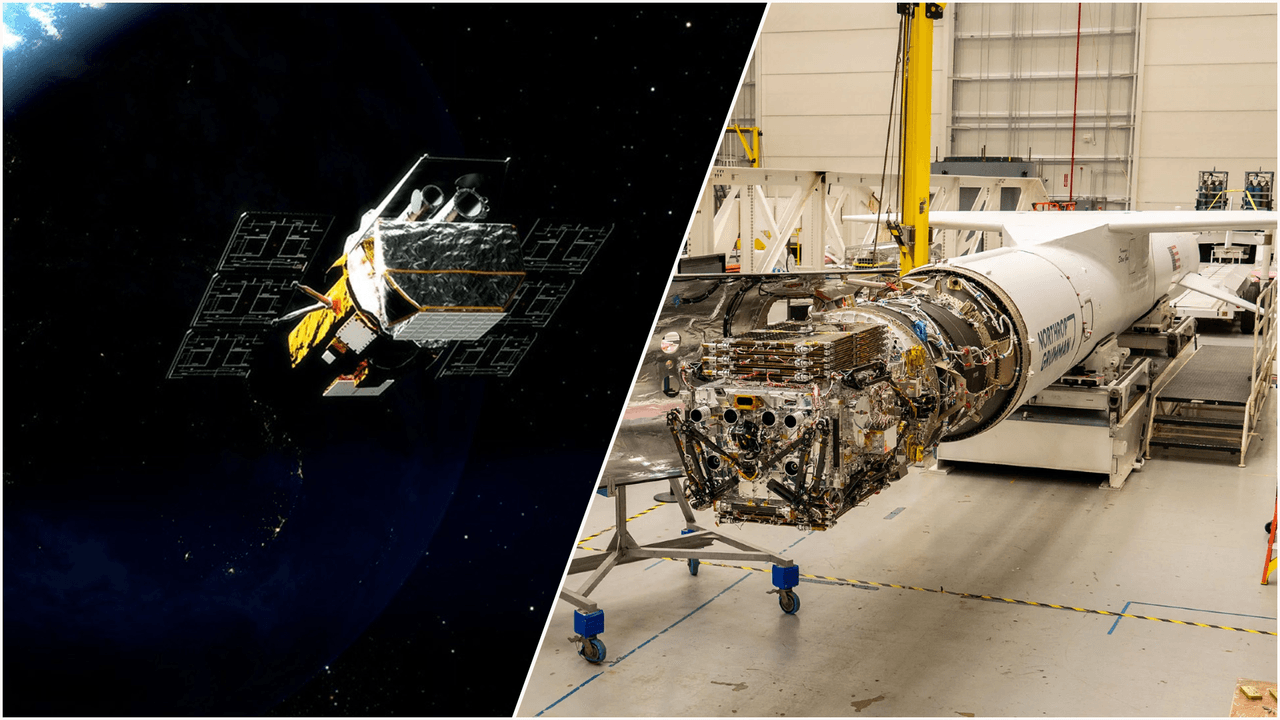
NASA’s Neil Gehrels Swift Observatory is falling out of space. NASA has a daring plan to save it with a spacecraft built by Katalyst Space. (Image credit: NASA) WALLOPS ISLAND, Va. — For over 20 years, NASA's Swift space observatory has been conducting prolific science in orbit, hunting for signs of gamma-ray bursts — the most powerful explosions in the universe. Now, it's falling to Earth, doomed to a fiery death by the end of the year as its orbit decays.But maybe not.NASA, it turns out, has a daring rescue mission in the works, something never before attempted in space: the Swift Boost mission. The endeavor calls for an untested spacecraft built by the Arizona company Katalyst Space Technologies to rendezvous and dock with Swift — something the observatory was never designed to do — before the observatory falls back to Earth.If all goes well, Katalyst's space tug (it's called Link) will lift the Swift observatory into a higher, safer orbit — one that will add years of life to the aging space telescope's mission. Liftoff is officially set for June 27, with Link launching on the last-ever Pegasus XL rocket, an air-launched booster built by Northrop Grumman."Frankly, I have to be honest: No one thought it was going to be possible," Shawn Domagal-Goldman, NASA's Astrophysics Division director, told reporters here on Wednesday (June 17). "No one thought we would get as far as we've already gotten today."What stands out most is how quickly the mission came together. NASA’s Neil Gehrels Swift Observatory, shown in this artist’s concept, orbits Earth as it studies the ever-changing universe. Launched in 2004, the space telescope's days are numbered as it is falling out of space. (Image credit: NASA’s Goddard Space Flight Center Conceptual Image Lab)It was just in September 2025 that NASA picked Katalyst to build a spacecraft capable of boosting Swift on a budget of $30 million. That was nine months ago. And now, the finished Link spacecraft — with its three robotic arms, three main Hall thrusters and a suite of other instruments — is packed aboard its Pegasus XL rocket and tucked on the belly of its L-1011 Stargazer carrier plane for a trip to its launch site in the South Pacific's Kwajalein Atoll."In the last nine months, we have gone from a clean sheet to a spacecraft that is currently integrated on a rocket on an airplane, ready to go to Kwaj for launch," said Kieran Wilson, Link's principal investigator at Katalyst Space, on Wednesday. "This is an absolutely unprecedented development timeline for this program."Yet that "swift" timeline, if you will, is essential if NASA is to rescue the Swift space observatory. Katalyst Space's LINK robotic servicing satellite awaits encapsulation inside a Northrop Grumman Pegasus XL rocket on June 8, 2026, at NASA's Wallops Flight Facility in Virginia. (Image credit: NASA/Ron Beard)NASA originally launched Swift (its full name is the Neil Gehrels Swift Observatory, after its late principal investigator) in 2004 on a $250 million mission to search the sky for gamma-ray bursts and other high-energy astrophysics phenomena in the cosmos. From its original orbit about 375 miles (600 kilometers) above Earth, Swift was a silent sentinel, ready to quickly pivot to new targets with unprecedented speed."Swift was designed to study gamma-ray bursts, short-lived flashes of high-energy light that release more energy in just a few seconds than the sun will in its entire lifetime," Swift principal investigator Brad Cenko told reporters Wednesday. "It's been extremely successful in this regard, detecting over 2,000 of these sources all the way out to the edge of the visible universe."It was Swift that helped scientists confirm without a doubt that the heaviest elements we know of, including the shiny gold and platinum in the jewelry you're wearing right now, were forged by these explosive cosmic events, Cenko said. Swift was expected to last two years in orbit. It's well into its second decade now, and sti