
Loading dispatches...
← Return to NewsroomScience
Can Venus cast a shadow? Here's how to see it for yourself
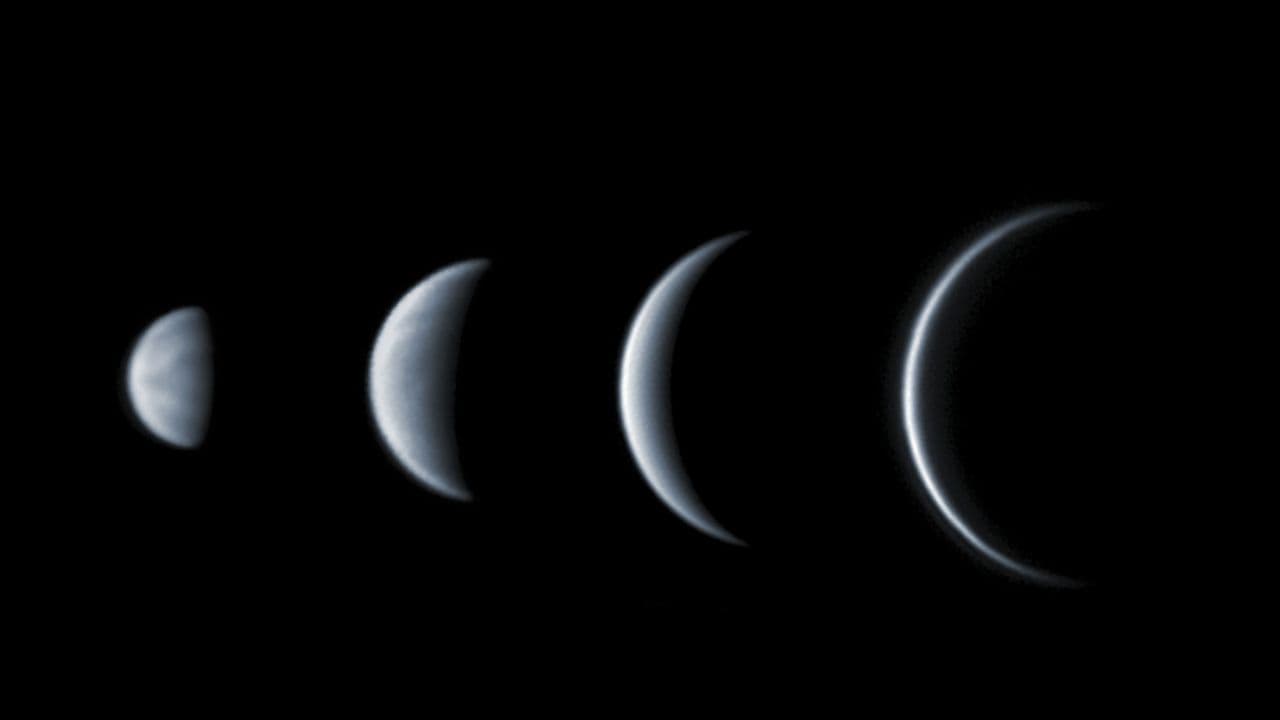
As Venus wanes to a crescent, its disk gets bigger, and it reaches its brightest. ( With Aug. 12's total solar eclipse — where the moon's dark silhouette is everything — now behind us, it's a good time to test another kind of celestial shadow.Astronomical folklore has it that the second rock from the sun, Venus, is, after the sun and moon, the third object able to cast a shadow when it's near peak brightness, albeit extremely faint, according to EarthSky.Is it true? Not in a city, where skylights glow and porch lights blaze, where shadows are mostly thrown by passing cars that appear to become the brightest object in the solar system briefly. Venus does cast a shadow, but the sky must be very dark, transparent and free of any light — apparently.Timing is everything. Having reached dichotomy — its half-lit phase — on Aug. 12, Venus is currently 49%-lit and waning as it moves closer to Earth, increasing in angular size as it becomes a slim crescent. Cue a surge in brightness, thanks to its reflective clouds and its closeness. Shouldn't it be brightest when it's "full?" No, because it's an inferior planet — i.e., it orbits closer to the sun — so it's fully lit only when it's on the other side of the sun from Earth, when its disk appears at its smallest.What’s happening and when to lookVenus is beautifully placed this week because it reaches greatest eastern elongation, its widest apparent separation from the sun in the evening sky. Look low in the west after sunset — Venus will be the bright white "star" that appears before the fainter stars even have a chance.On Aug. 14-15, it sits about 46 degrees from the sun and shines at a magnitude of -4.3 to -4.4, bright enough to dominate twilight but not quite at its most impressive stage of the apparition. The real test comes around Sept. 18, when Venus reaches its greatest brilliancy at magnitude -4.6. Sadly, by then it's going to be rather low in the sky from mid-northern latitudes, making observation from the U.K. difficult, but possible from most of the U.S. Venus shines over the Mitsuke Iwa Rock in Ishikawa, Japan. ( Face Venus and place a white surface (a white card or sheet works well) also facing Venus. You'll also need to position something in front of the card to cast a shadow. Although it is possible to see the faint shadow of Venus, photographing the card is the best way to capture it, using a technique similar to that for any night sky photograph — a high ISO, a wide aperture and a long exposure of up to 30 seconds. It may be wise to test the location, find the best line of sight, and work out where the card needs to go while Venus is still high enough above the western horizon.If you're not in a good location to catch the shadow of Venus, instead try to see and photograph the light from Venus reflecting on water. Any pond, lake or ocean you can get between you and Venus ought to catch its shine in a long exposure image. That identical technique — high ISO, a wide aperture and a long exposure — will also apply, but this time you can actually aim your camera at Venus!Stargazer’s Corner: August 14-20, 2026This is an excellent week for darkness and faint objects. With new moon on Aug. 12, this week is all about a crescent moon. On Aug. 15 you may catch a 12%-lit waxing crescent close to Venus, but more likely you'll see it on Aug, 16, when it will be 19%-lit. The latter occasion is one to aim for — a beautiful sight. On both occasions, look for "earthshine" on the darkened limb of the moon — sunlight reflected by Earth, and something else you can try to capture with a long exposure. The waxing crescent moon will be low in the
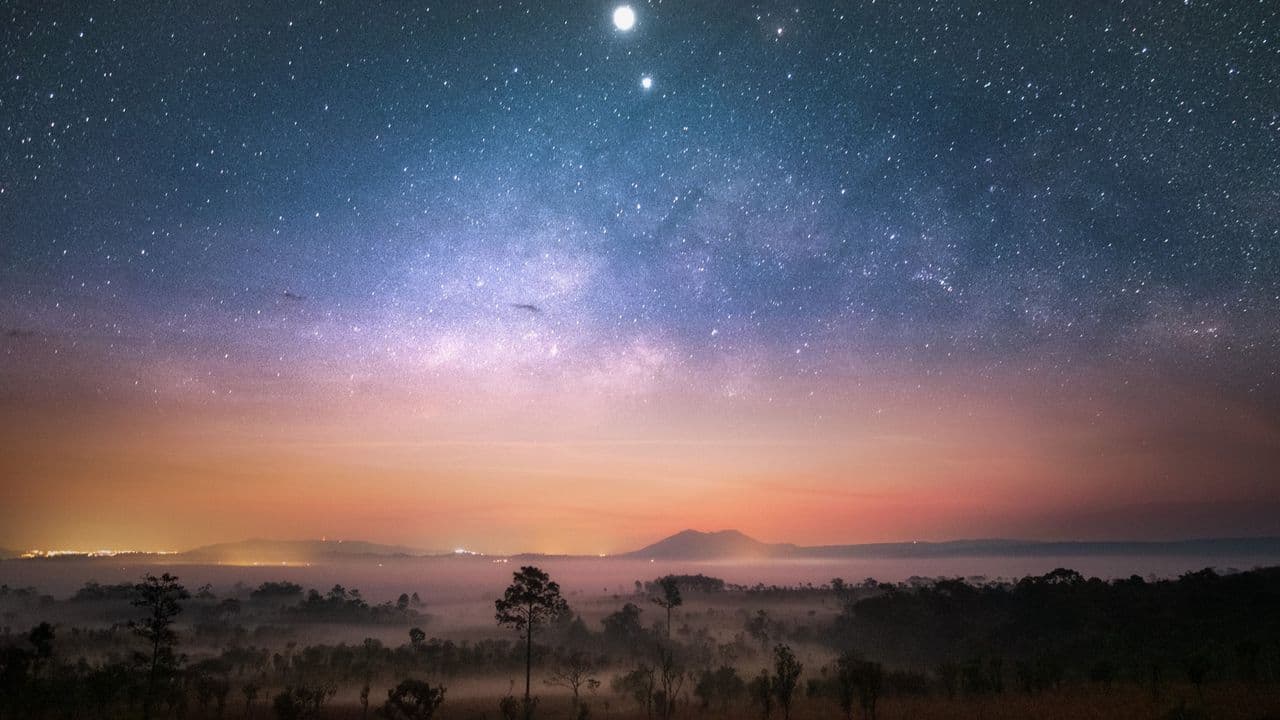
The Milky way over Thung Salang Luang National Park, Thailand. (From our vantage point on Earth, Venus reaches the end of its tether to the sun on the evening of Aug. 15, when it is at greatest elongation 46 degrees to the east of the sun. And yet, paradoxically, instead of appearing high up in the west, Venus is getting noticeably lower to the west-southwest horizon as the month progresses. This is because its declination in the sky is taking it well to the south of the sun. In fact, Venus's greatest elongation coincides with the time that it sets right at the end of evening twilight.During the second half of August, into September, Venus will no longer be setting in a dark sky, but rather in a progressively brighter twilight sky. This is all due to its increasing southerly declination and the fact that the ecliptic — the apparent path of the sun, moon and planets through the zodiacal constellations — appears to slope closer to the western horizon at sunset during late summer and early fall.The planet best positioned for telescopic observation this month is the "Lord of the Rings," Saturn, which comes up during late evening and is in a commanding position, well up in the south-southeast at the break of dawn. Your hand held at arm's length can be a handy tool for measuring the night sky. ( During August, Earth approaches it at an average daily rate of 425,800 miles (685,100 kilometers). Still, even at month's end, Mars will be 172.2 million miles (277.1 million km) away, so while it continues to brighten, that process will still be quite slow.Mercury and Jupiter are morning objects. Mercury will be evident during the first half of August, low in the east-northeast within about an hour of sunrise. It will be joined at midmonth by Jupiter as that big world emerges into view out of the glare of the rising sun.In our schedule, remember that when measuring the angular separation between two celestial objects, your clenched fist held at arm's length measures roughly 10 degrees. Here, we present a schedule below which provides some of the best planet viewing times while directing you as to where to look to see themMercuryMercury reaches greatest elongation from the Sun (19 degrees) on the morning of Aug. 2; it should be an obvious, +0.2-magnitude point low in the east-northeast if you look 50 minutes before sunrise. About a week later, look for Mercury very low in the east-northeast about an hour before sunrise. This small fleet world gets lower each dawn in early August, but it also rapidly brightens, from magnitude -0.7 on Aug. 9 to -1.3 (a trifle fainter than the brightest star, Sirius) by Aug. 16. Castor and Pollux point the way to Mercury predawn on Aug. 9. ( 9, Castor and Pollux, the "Twin Stars" of Gemini, point directly toward Mercury. Just extend an imaginary line twice the distance between these two stars, down toward the east-northeast horizon and you'll come to Mercury. Early on the morning of Aug. 11, an exceedingly thin crescent moon — just 2% illuminated and about 32 hours from new (and a solar eclipse) — will lie about 2 degrees to the upper left of Mercury. From Aug. 13 through Aug. 17, Mercury will engage in a close interaction with Jupiter. Mercury arrives at superior conjunction with the sun on Aug. 27 and transitions into the evening sky.VenusVenus continues to outshine August's other evening stars and planets by a huge margin, brightening from magnitude -4.2 to -4.5 over the course of the month. It reaches its greatest elongation from the sun (46 degrees) on the evening of Aug. 15 and now resembles a roughly half-moon phase (48% illuminated) through a
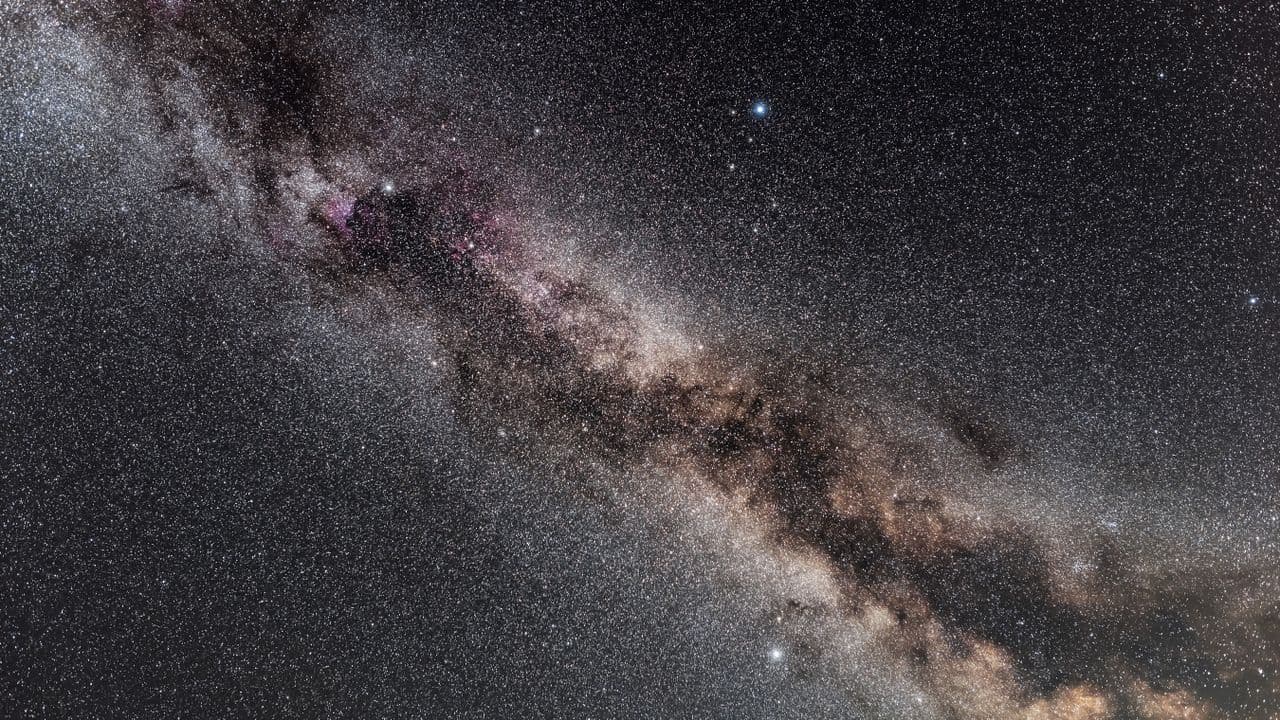
The Summer Triangle stars are a signpost to the Milky Way. ( Every time I step outside at night, I instinctively look overhead for the Summer Triangle. Not because it's the most spectacular sight in the sky. In fact, the vast asterism is almost suspiciously simple: three bright stars, large enough to cut through twilight and light pollution without much effort.Experienced stargazers quietly depend on the Summer Triangle more than we admit. People imagine astronomy involves memorizing the entire sky at once, knowing exactly where each star is and what it's called. Everyone navigates differently, but we all rely on familiar anchor points because the night sky changes quickly with the seasons.The Summer Triangle is one of the best anchors because it appears exactly when the northern sky can otherwise feel vague and washed out during late twilight. Once those three stars appear, I immediately know where everything else is. The Milky Way becomes easier to trace. The darker regions of the sky reveal themselves. Constellations stop looking random. Suddenly, I know where the Perseids will emerge from later in the night and where to point binoculars to find summer's dense star fields without even thinking about it.The Summer Triangle also teaches you how to see the night sky. To the untrained eye, the night sky appears as a flat backdrop of stars — hence the "blanket of stars" saying. Every time I hear that cliche, I wince. There is no blanket! The night sky has incredible depth, and there's nowhere better to learn how to appreciate that than when gazing at the Summer Triangle.Take Altair, the lowest star. It's relatively nearby at about 17 light-years away. It shines brightly largely because it is close to us. Vega lies slightly farther away at roughly 25 light-years, but it is intrinsically far more luminous. It once served as Earth's North Star thousands of years ago and, thanks to our planet's slow axial wobble, will become the North Star again many millennia from now. So far, so local — we're in the sun's backyard with these two stars. The light from both of them began its journey to us this century.Then there's Deneb. Deneb is so distant — roughly 2,600 light-years away — that the fact it appears this bright at all becomes genuinely difficult to process. Its light began traveling toward Earth while the Roman Empire was still in existence. The only reason it remains prominent in our sky is that Deneb is an enormously luminous supergiant radiating tens of thousands of times more energy than the sun.Knowing this about Deneb transforms the Summer Triangle into a three-dimensional shape. Here are three stars that appear neatly connected overhead, but in reality, one is separated by an incomprehensible distance. So next time you look at the Summer Triangle, keep Altair and Vega at the front and push Deneb way, way back. It's not a triangle anymore — it's an arrow pointing far into the distance, thousands of light-years away into the starfields of the distant Milky Way.What's happening and when to look Deneb is vastly farther from the sun than Altair and Vega. ( Around 11 p.m. local time at mid-latitudes of the Northern Hemisphere, look high in the southeast. Vega is usually the first to appear, high and brilliant with a slightly blue-white color. To its lower left sits Deneb. Farther south is Altair. By midnight, the entire Summer Triangle stands high overhead and remains one of the defining features of the northern summer sky through October.Stretching directly through it is our view into the Orion Arm of the Milky Way — the spiral arm of the galaxy containing the solar system itself — while farther south, the glowing river of starlight continues toward the galactic
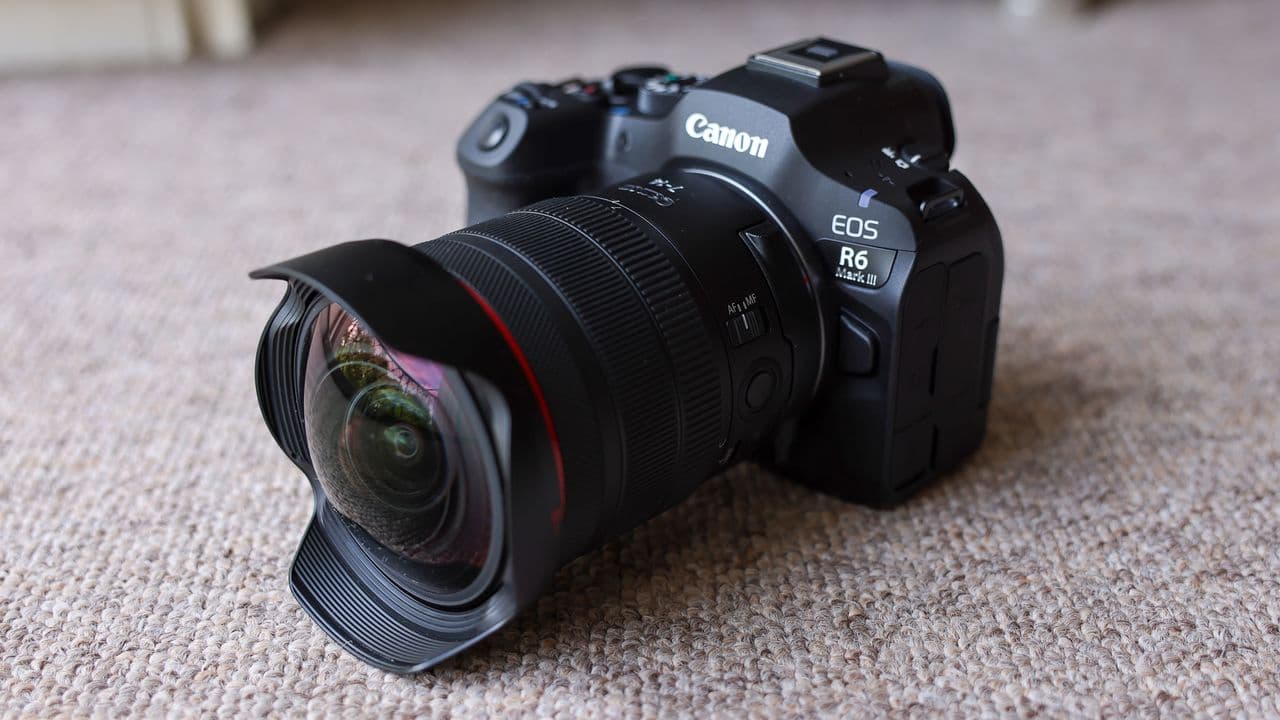
The latest version of the Canon EOS R6 brings more resolution, a CFexpress slot and better low-light autofocus for astrophotography but it's likely to be overkill for beginners and outprice enthusiasts Pros +Fast low-light autofocus +Strong 32MP resolution +CFexpress card slot Cons -Very expensive -Overkill for beginners Why you can trust Space.com Our expert reviewers spend hours testing and comparing products and services so you can choose the best for you. Find out more about how we test and review products. In a rare first for me, I actually used autofocus for this entire astrophotography shoot. If I'm being honest? I prefer it when shooting astro with a mirrorless camera. Why? Because it is quicker and that means more time capturing the stars and less time setting up. I can get a star in sharp focus using autofocus in half the time that it would take me to do it manually and it's way easier to focus with the shutter or back button than play about with the focus ring, especially with cold fingers. The Canon EOS R6 III makes shooting astro much quicker with its rapid low-light autofocus. ( After setting up my tripod, I was ready to start shooting, armed with the Canon 14mm f/1.4 and 45mm f/1.2 lenses. Image 1 of 2 Pairing the R6 III with the RF 14mm f/1.4 lens is a perfect set up for astrophotography. ( Everyone does. Whilst the manual focus (MF) versus autofocus (AF) debate continues within the community, the technology for low-light autofocusing capability has come a long way since mirrorless cameras were first introduced and the R6 III is physical proof of that.The astrophotography Mizar and Alcor in the panhandle of the Big Dipper. Shot with Canon EOS R6 III and RF 45mm f/1.2 lens, Aperture: f/1.2, Shutter speed: 2 sec, ISO 500 | Bortle class 4. ( All three versions of the Canon EOS R6 feature a low-light autofocus range of -6.5 exposure value (EV), so they already have a strong baseline for shooting under dark skies. The Canon EOS R6 III features a higher resolution and advanced autofocus algorithms, so the AF system actually has more data to use and is better at using it.I was able to capture bright objects easily and start shooting without having to spend ages using manual focus for each new shot. The autofocus was powerful enough to capture at least one star in each of my frames. I simply used autofocus on the brighter points of light in my composition, waited for the green box and then switched to manual to avoid any refocusing if I decided to recompose the shot. Pollux and Castor above Jupiter. Shot with Canon EOS R6 III and RF 45mm f/1.2 lens, Aperture: f/1.2, Shutter speed: 2 sec, ISO 500 | Bortle class 4. ( Light pollution washed out the contrast in this shot but it was the quickest autofocus because of the brightness of the objects.The autofocus helped me capture a range of other constellations too. With the R6 III focusing on the bright star Arcturus, along with the rest of Boötes and Coma Berenices next to the Coma Star Cluster (Melotte 111). Arcturus, Boötes, Coma Berenices and the Coma Star cluster (Melotte 111). Shot with Canon EOS R6 III and RF 14mm f/1.4 lens, Aperture: f/1.4, Shutter speed: 8 sec, ISO 800 | Bortle class 4. (
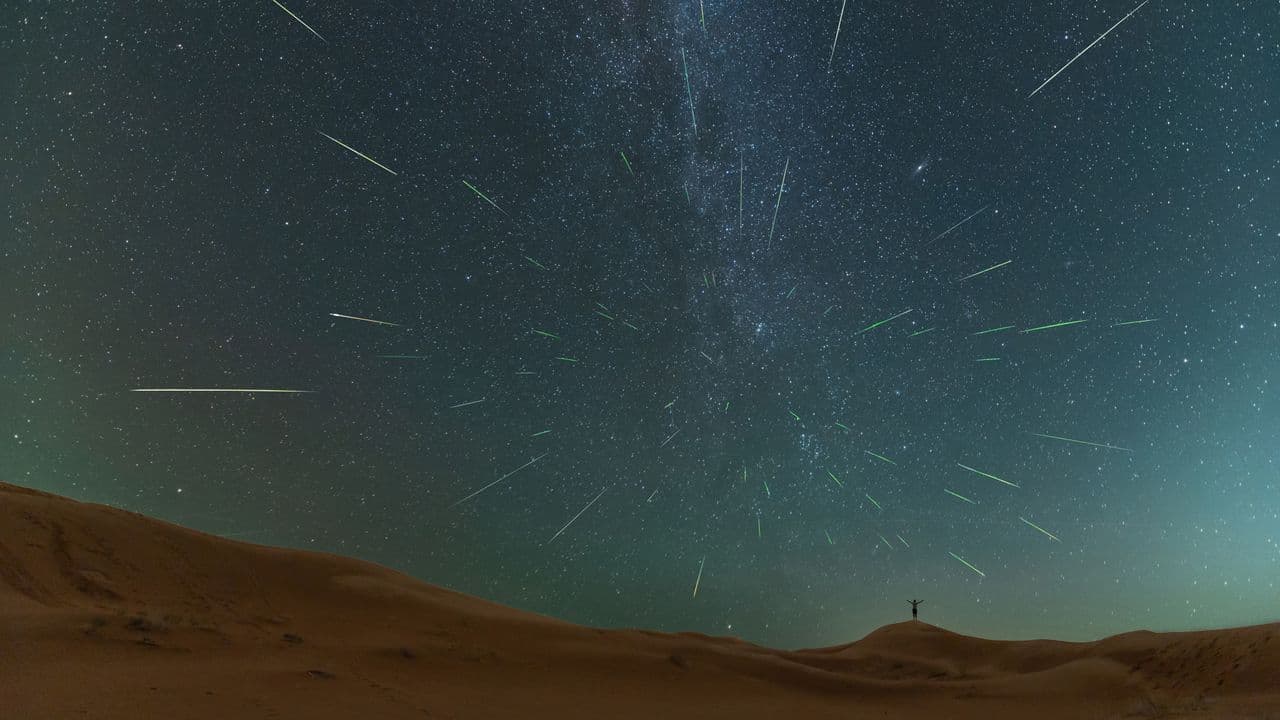
A composite view of meteors streaking through the sky over Inner Mongolia, China in 2023. ( The Perseid meteor shower is finally active, bringing the potential for gorgeous shooting stars and fireballs as Earth plunges into the trail of debris shed by the icy comet Swift-Tuttle. Here's what you need to know.The Perseid meteor shower 2026 is set to be a truly magnificent affair and a stark contrast to last year, when moonlight drowned out all but the brightest shooting stars. The shower will reach peak activity overnight on Aug. 12-13 under the dark skies of the new moon. During the peak, up to 100 shooting stars may be seen each hour as they cut fiery paths through the summer sky, according to the American Meteor Society.You could even spot a Perseid brightening the false twilight triggered at the climax of the Aug. 12. eclipse, as the moon perfectly hides the surface of our parent star. But for that to happen you'd have to find yourself in the path of totality just as a large fireball-producing meteoroid struck Earth's atmosphere. It's certainly possible, but let's just say that the odds aren't stacked in your favor.If you're not in the path of totality then there's no need to despair, you stand a much better chance of spotting Perseids the old fashioned way anyway!How to spot Perseid shooting starsPerseid meteors can be spotted anytime after dark from tonight onwards, streaking away from a patch of sky, or radiant, located close to the red supergiant star Eta Persei in the constellation Perseus. How to measure distances in the night sky using your outstretched hand. ( Next, find a patch of sky 40 degrees above it, and settle in for one of the year's premier natural light shows. This is where the shooting star trails will be at their longest.The Perseids are also famed for producing vivid green fireballs capable of briefly turning night to day as larger chunks of debris collide with Earth's atmosphere at speeds of up to 37 miles per second (59 kilometers per second).When to look for Perseid meteorsPerseid meteors may be spotted anytime from 10 p.m. onward for viewers in the U.S., though the number of visible shooting stars will be higher in the hours before dawn, when the radiant rises to its highest point in the summer night sky. Try to head away from city lights and allow at least 20 minutes for your eyes to adapt to the darkness.Relatively few shooting stars will be visible in the days following the shower's awakening compared to the peak. However, if you do catch one, you'll have seen the demise of a meteoroid that's likely been flying through space for thousands of years before reaching Earth.Nikon Z8 ( It features a full-frame 45.7MP sensor, 8K video capabilities and, of course, excellent low-light performance. Check out our Nikon Z8 review for more."The meteors we see early and late during the activity are most likely the oldest as they have obviously been perturbed from the main orbit of the comet, which we encounter in mid-August," said Robsert Lunsford of the American Meteor Society in an email to Space.com.The greatest number of meteors can be seen in the predawn hours of Aug. 13 as the shower reaches peak activity, when Earth passes through the densest section of the debris stream left behind by comet Swift-Tuttle.Want to capture your own photos of the Perseid meteor shower? Then be sure to read our guide detailing how to image shooting stars, along with our roundups of the best cameras and lenses for astrophotography.Editor's Note: Did you capture a photo of a Perseid and want to share it with Space.com's readers? Then please send your photos and comments, along
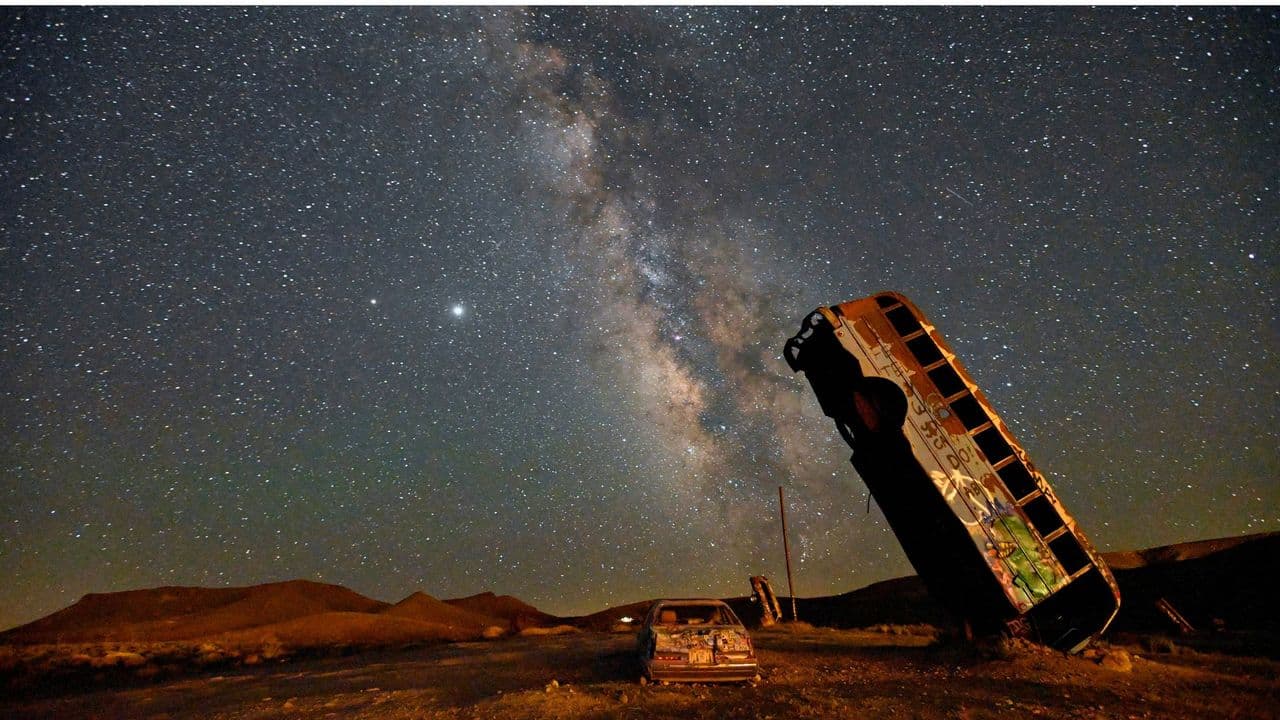
The Milky Way arches into the skies over Nevada. (Celestron NexStar 4SE ( For a more in-depth look at our Celestron NexStar 4SE reviewOur celestial sightseeing targets run the gamut from lone stars and constellations to historic lunar landmarks and an uncannily shaped nebula — some of which will require a small telescope or a camera to truly appreciate.If you're new to the night sky, then you may want to check out our roundup of the best stargazing smartphone apps, which will help you navigate to specific targets using augmented reality technology.Apollo 11 landing site One of America's finest moments came on July 20, 1969, as Apollo 11 astronauts Neil A. Armstrong and Edwin E. "Buzz" Aldrin Jr. took humanity's first steps on the surface of Earth's moon. Here's how to spot the region of the moon that contains the Apollo 11 "Tranquility Base" landing site with the naked eye on the weeks surrounding a full moon. The Sea of Tranquillity can be found close to the terminator line seperating night from day on July 4. ()First, find the dark expanse of Mare Tranquilitatis darkening a swathe of the moon's eastern limb close to the equator, where ancient lava flows once filled networks of impact basins before solidifying to create vast basaltic plains. The location of the Apollo Landing site in the Sea of Tranquillity ()The Apollo 11 landing site is located on the southwestern shore of the Sea of Tranquility, between the Sabine and Moltke impact craters, which can be spotted with the aid of a small telescope. You can also search for the Apollo 11 backup landing sites using our handy guide, or even attempt to find where each Apollo-era mission touched down on the lunar surface.SpicaThe United States' relationship with the night sky dates back to its founding. After all, the stars depicted on the nation's earliest flags were intended to symbolize the birth of a new constellation, with each representing one of the 13 original colonies that formed the early union, according to the Smithsonian Institution. Spica shines blue-white against a sea of fainter stars. (0 International license.)You can honor that spirit on the nation's semiquincentennial anniversary by finding a star whose light left its surface around the same time that the United States declared its independence!The blue-white double star system Alpha Virginis — known better as Spica — is located roughly 250 light-years from Earth in the constellation Virgo. As such, the light cast out from its surface some 250 years ago is only now reaching Earth, having traveled for centuries through the near vacuum of space at the speed of light — a blistering 186,282 miles per second (299,791 kilometers per second). You can locate Spica using the stars of the Big Dipper asterism in the western sky. ()To find Spica, you first need to locate the seven bright stars of the Big Dipper asterism above the northwestern horizon after sunset, and trace an imaginary line along the curve of the Big Dipper's handle. Do that, and you'll come across the bright orange star Arcturus, the 4th brightest star in the night sky. Continue that arc beyond Arcturus and the next bright blue-white star you find will be Spica!The constellation AquilaNext up, we have the constellation Aquila, the "Eagle", which shines along the glowing ribbon of the Milky Way in early summer. The constellation evokes the shape of a great
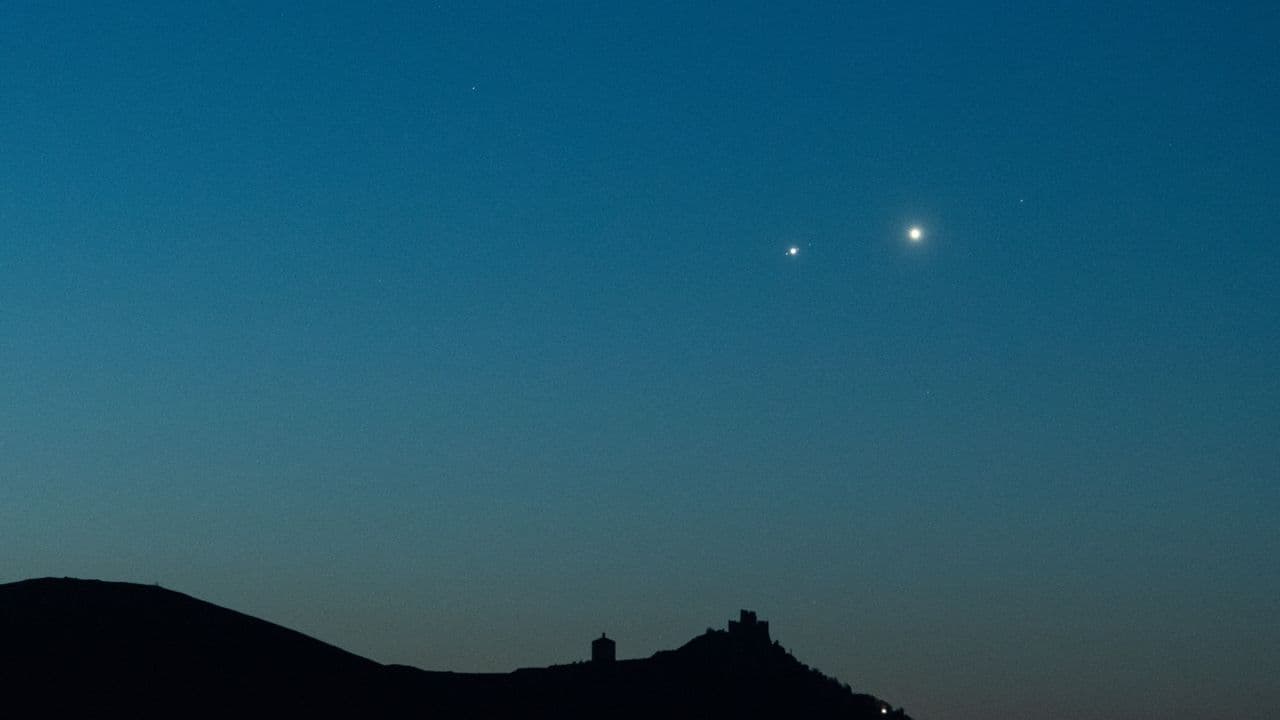
Jupiter and Venus approach conjunction behind Rocca Calascio castle in Italy on April 30, 2022. (Sunlight will reflect off the cloudy tops of Venus and Jupiter before journeying millions of miles to enter Earth's sky in almost the same place, making the planets appear very close to one another on Tuesday (June 9). But in reality, the two planets will be separated by at least four Earth-sun distances in space.A conjunction between Jupiter and Venus also happened just ten months ago, in August 2025. Before that, in May 2024, preceded by March 2023. Its occurrence roughly once every year is a sign of a wonderful arrangement of planets that may be absent around other stars. And as it turns out, the conditions that set Venus and Jupiter up for their conjunction are the same that are critical for life to survive on Earth.'Pie' in the skyThanks to the explosion of exoplanet discoveries over the past decade, planetary scientists like Kat Volk, who works at the Planetary Science Institute in Tucson, Arizona, know there are many distant worlds taking wonky and puffed-up loops around their parent stars. But the solar system is more like a pie of pizza.The flat-disk shape means that, although the sky is a huge dome above our heads, the planets can only appear in part of it.Venus, Jupiter, and their planetary siblings travel in almost concentric circles around the sun. That means that the planets appear just a handful of degrees above or below the sun's apparent path through the sky, called the ecliptic. (The ecliptic is really the Earth's orbital plane, but from our perspective it appears as though the sun is in motion.)The Earth's orbital plane is only tilted a little relative to the average plane of the solar system, called the invariable plane, Volk tells Space.com."That's why, as we're watching them in the sky, they're all kind of following a path along the ecliptic plane."It's all reflective of how the sun and the planets formed, said Volk."When the sun was being born out of some cloud of gas and dust, it was collapsing down to form the star. Then, angular momentum caused the material surrounding that [star], that didn't make it into the sun, to form a disk that is rotating and orbiting around the star. The really massive bodies in the solar system — the planets — tended to form within that disk," said Volk. A simulated view of the orbits of the planets on June 9, 2026. ( Some systems deviate significantly from this proto-structure. "If there's another Earth out there, there's no guarantee that the observers on that 'Earth' would see the same kind of nice ecliptic plane that we see in our solar system."Our cosmic neighborhood is flat and relatively circular, but that is not universal. "The sun isn't by itself in the galaxy," said Volk. "A lot of stars form in clusters. Sometimes stars actually interrupt and interact with each other," which could boot baby planets into a "wider range of inclinations."Larger planetary tilts may have happened in the ancient past to our solar system. But after the gas giants migrated from nearer to the sun to the cold reaches they inhabit today, the inner planets and the remaining mass of small bodies like comets and asteroids likely helped to balance out their orbits.As a result, Earth gets to inhabit what's known as a "dynamically cold" configuration. The planets coast past one another on the ecliptic, and appear to us to nuzzle one another every so often. Jupiter and Venus as seen during conjunction over Italy on April 30, 2022. ( Orbital dynamics control the distance a planet is from
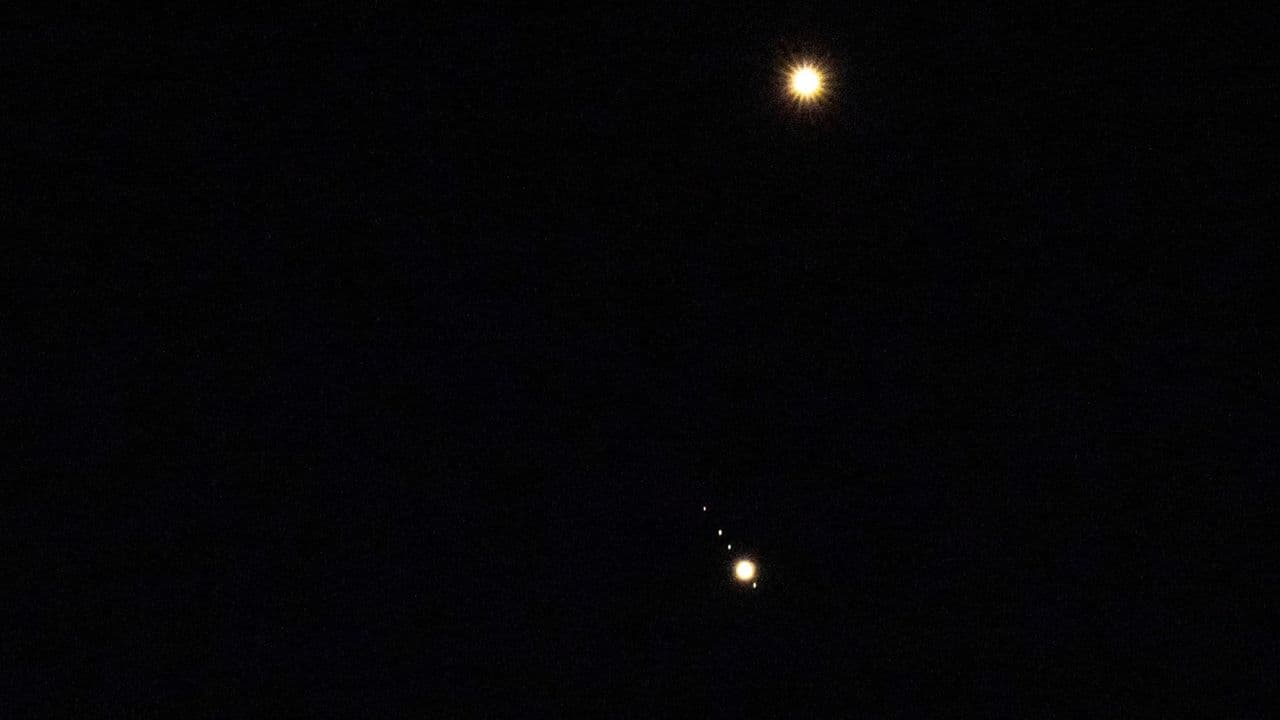
Get ready for a spectacular sight on June 9, as Jupiter and Venus make a close approach in the evening sky, while Mercury shines close to the western horizon in the glow of the setting sun.Stargazers in the U.S. will see the bright light of Venus glowing less than 20 degrees above the horizon at sunset — roughly the width of two clenched fists held at arm's length — with Jupiter to its lower left. Mercury, meanwhile, is more challenging to spot, as it shines approximately 10 degrees below and to the lower right of the pair, requiring a clear view to the west.Venus and Jupiter will be separated by less than 2 degrees in the night sky — close enough to share the field of view of a pair of 10x50 binoculars. You may also be able to spot Jupiter's four Galilean moons — Io, Europa, Callisto and Ganymede — appearing as tiny star-like points of light surrounding the gas giant.The following nights will see Venus rise above Jupiter as it tracks a path toward the heart of the nearby constellation Cancer, where it will shine with the open star cluster Messier 44 — also known as Praesepe or the Beehive Cluster — on June 20.Celestron NexStar 4SE ( It's sturdily built, quick to set up and automatically locates night sky targets and provides crisp, clear views of them. For a more in-depth look at our Celestron NexStar 4SE reviewJupiter, meanwhile, will be progressively harder to spot following its rendezvous with Venus on June 9, appearing fractionally lower on the horizon with each passing night. By early July, the gas giant will be a challenge to spot in the glow of the setting sun, and won't be seen again until mid-August, when it reappears in the eastern morning sky.Want to get a closer look at the planets? Then be sure to read our roundup of the best telescopes available in 2026. If you're a photographer, then you may also want to read our guide to the top smart telescopes for capturing the night sky, along with our picks of the most capable cameras and lenses for astrophotography.Editor's Note: If you would like to share your astrophotography with Space.com's readers, then please send your photo(s), comments, and your name and location to spacephotos@space.com.
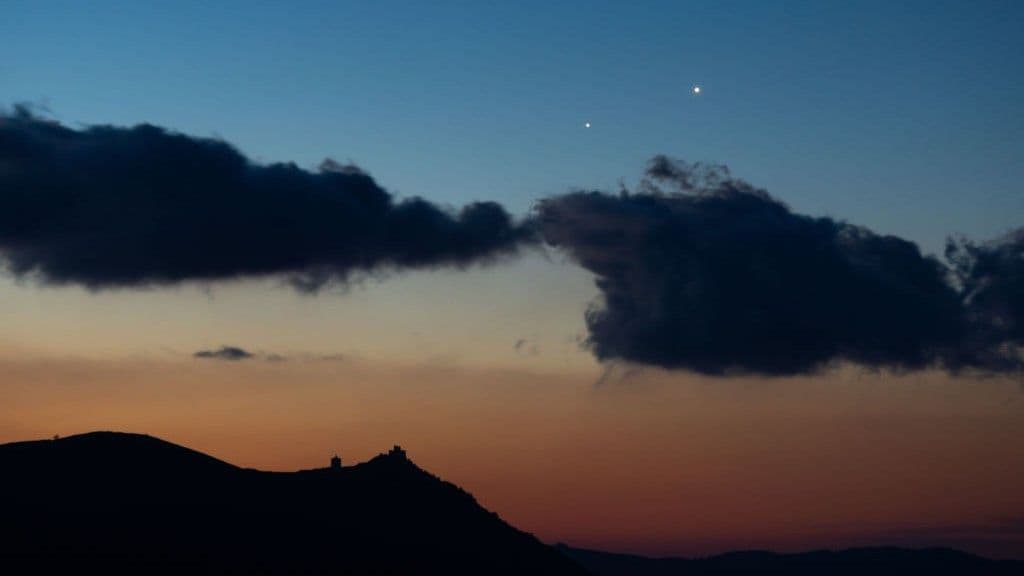
Planets Jupiter and Venus reaching their conjunction rise before sunrise behind Rocca Calascio castle, Italy, on April 29, 2022. (A spectacular gathering of three planets, two bright stars, plus, later this month, a slender crescent moon, will be the chief celestial attraction in the evening sky during the next few weeks. It will, in fact, be possible for anyone with a clear and unobstructed view of the western sky to see all three planets at a single glance.And two of these planets — Venus and Jupiter — are by far the brightest of those that are readily visible with the unaided eye. In fact, on one particular evening, Tuesday, June 9, these two worlds will seem to "call attention to themselves," even to those who normally do not look up into the night sky.Jupiter and Venus draw togetherNo doubt during the past week or so, even casual sky watchers have already taken note of Venus and Jupiter in the guise of two very bright "stars" that have been evident in the west-northwest sky for at least a couple of hours after sunset.Both shine with a silvery-white luster and one — Venus — appears considerably brighter. And especially noticeable over the course of recent nights is that they seem to be drawing closer to each other. In fact, at this moment in time, from our earthly viewpoint, they literally are like two celestial ships passing in the night. Jupiter will appear about one-seventh as bright as Venus. Night sky on June 7, 2026. ( They'll be separated by 2.3 degrees. On June 8, Venus will have moved to the upper right of Jupiter, the gap between them having been reduced to 1.8 degrees. Night sky on June 8, 2026. ( The actual closest approach, with Venus sliding just 1.6 degrees above (north) of Jupiter, will take place at 12 hours Universal Time (UT), which is during the daytime for North America. At that time, just over three times the apparent width of the full moon will separate these two planets. Nonetheless, even though they will already be in the process of slowly separating as darkness falls later that evening, the two planets will still appear practically as close as they were just hours before.Thereafter, Jupiter will appear to drop rapidly away from Venus, setting progressively earlier and becoming more and more deeply immersed in the bright evening twilight during the balance of June. It will likely disappear in early July. Night sky on June 9, 2026. ( All through June, it will appear each evening more than 25 degrees high in the west right after sunset and will not drop below the horizon until at least 2.5 hours later. During this time, Venus will be setting unusually late in the evening, not disappearing beyond the west-northwest horizon until after 11 p.m.Mercury joins the lineupWhile all this is taking place, a third planet will be evident below Venus and Jupiter. That third planet will be Mercury.Mercury is often cited as the most difficult of the five bright planets to see. Called an "inferior planet" because its orbit is nearer to the sun than the Earth's, Mercury –scarcely more than half as far from the sun as Venus is — always appears from our vantage point to be in the same general direction as the sun and it's usually lost in the sunlight. Yet it's not really that hard to see. You simply must know when and where to look and find a clear horizon.And for those living in the Northern Hemisphere, a gr
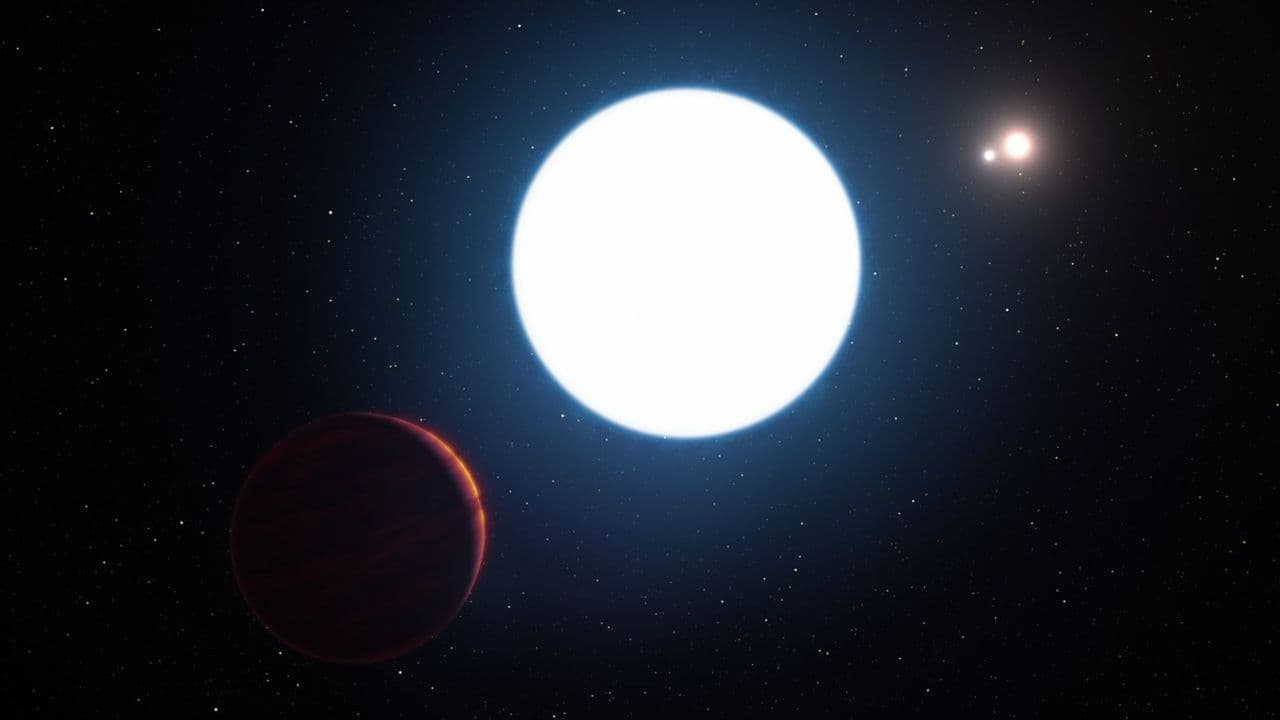
An artist's impression of a planet orbiting a star in a triple system. ( Calçada/M. Kornmesser) A triple star system in which the stars all eclipse one another from our vantage point is standing out as one of the best studied stellar trios; as the stars age, they could even merge.The triple system, known as TIC 295741342, is 3,080 light-years from Earth and was found by NASA's TESS (Transiting Exoplanet Survey Satellite) mission. It features a binary system composed of two stars almost identical to the sun, orbited by a larger third star of 1.7 solar masses.Triple star systems abound in the galaxy, but what makes TIC 295741342 more remarkable is that all three stars orbit each other in the same plane, and that plane is aligned edge-on to us.TESS charts the light curves of stars, which is essentially a graph of brightness versus time. Typically, it is looking for the small dip in light as an exoplanet moves in front of, or transits, its star, but TESS also excels at witnessing stars in binary and triple systems also moving in front of each other — not just transiting, but eclipsing.The light curve for TIC 295741342 is described by Brian Powell, who is an astronomer at NASA's Goddard Space Flight Center, as having a "head-and-shoulders" pattern, especially when inverted. TESS detects a dip in light as the stars of the binary at the heart of the TIC 295741342 eclipse one another. This dip is one of the "shoulders." Then, TESS detects another, deeper dip in light as the third, outermost star moves in front of the binary and eclipses both its stars, creating the "head."As the binary moves out from behind the third star while still eclipsing each other the light curve steps back up to the initial dip in light – the other "shoulder" — and finally back to full brightness when no stars are in eclipse.Powell told Space.com that "very few known triple star systems are so near-perfectly coplanar as TIC 295741342, especially for being such a wide system."Disk fragmentationBy coplanar, Powell means that all three stars orbit in the same plane, just as the planets of the solar system orbit in more or less the same ecliptic plane. Our planets are found in the same plane (or more specifically, within six degrees of it) because they formed from a disk of gas and dust that ringed the young sun. Powell suspects the stars of TIC 295741342 also formed from a disk, but one that fragmented."The protostellar disk broke into pieces to form stellar companions," said Powell.Not all triple systems form this way. In many cases, the third star orbits at an angle to the central binary — but in those scenarios, the third star was gravitationally captured by the binary while they were all still in the close confines of their birth cluster.Disk fragmentation is not a rare phenomenon, however. Hundreds of coplanar triple systems have been found, their numbers enhanced in particular by the discoveries made first by NASA's Kepler Space Telescope and now TESS. Yet few triple star systems are as well studied as TIC 295741342. An example of a 'head and shoulders' light curve from a triply eclipsing star system (75 days. Separated by a distance of about 6.61 million miles (10.6 million kilometers); their masses were deduced from radial velocity measurements by the spectrograph on the 1.5-meter Tillinghast reflector at Whipple Observatory in Arizona. The third, outer star takes 412.8 days (1.13 years) to orbit the binary pair, at a distance of 157.7 million miles (253.7 million kilometers).This is considerably wider than many other triple eclipsing stars that have been found, such as Lambda Tauri, which was identified in 1956 as the first known eclipsing triple where the outermost star has a 30.5-day period. Even closer is TIC 290061484, an eclipsing triple found by TESS in 2024, where the central binary has a period of 1.8 d
Discussion (0)